Plastic has a journey after we lose sight of it at the shore. A fragment moving with the waves knows neither city boundaries nor national borders. Following a release east of Japan into the Pacific brings a distant environmental problem back to the things people use and discard on land.
On 27–30 September 2026, heads of delegation met informally to prepare for the next stage of international negotiations on plastic pollution. The negotiating mandate covers the full life cycle, including production, design and use. Understanding what happens after plastic reaches the sea and considering what happens before it gets there are two sides of the same problem. [1] [2]
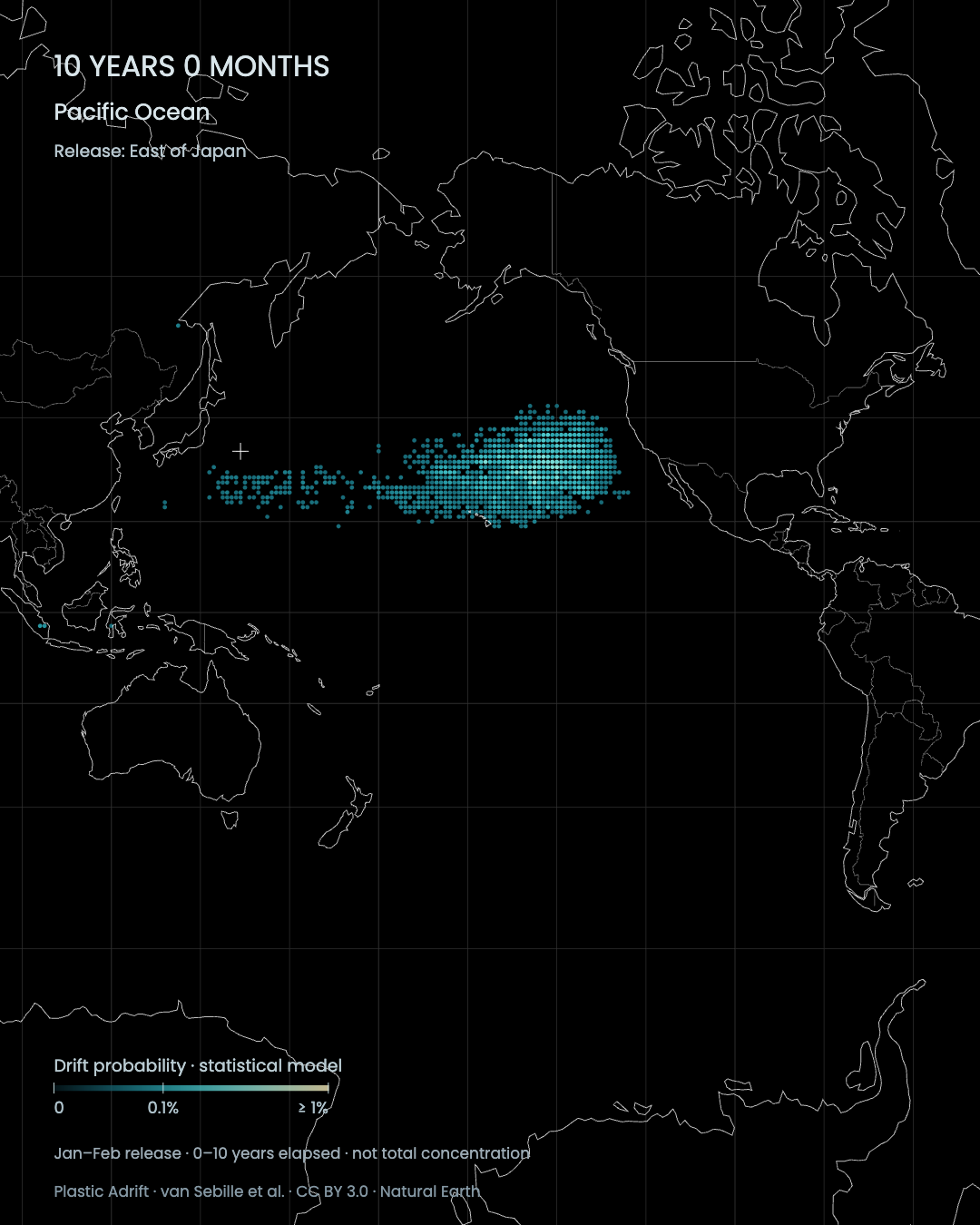
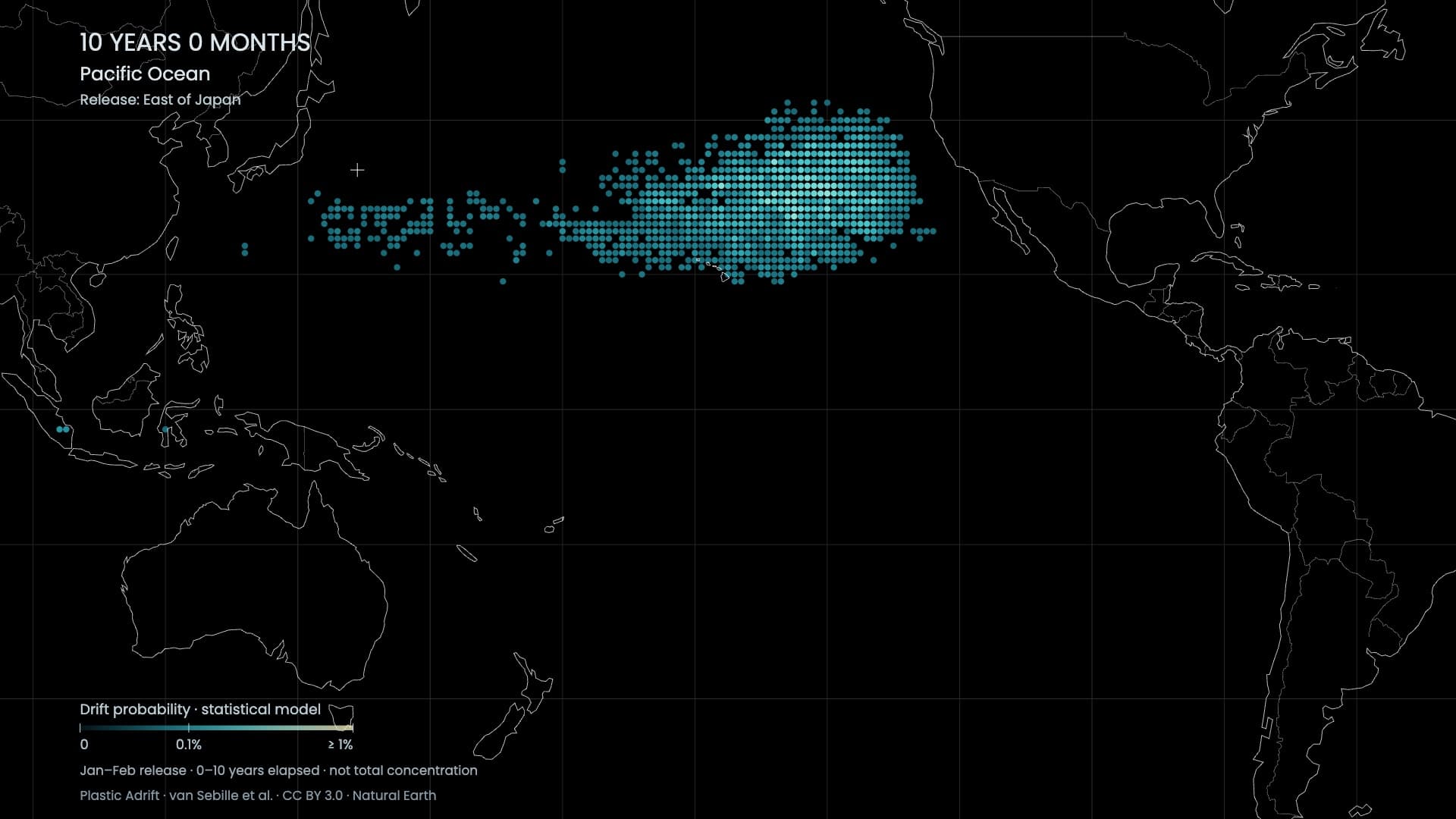
Modelled drift probability after a January–February release east of Japan. Plastic Adrift.
The Pacific has pathways that bring floating material together
Surface winds, currents, eddies and seasonal conditions influence where floating material travels. Entering a large ocean does not ensure even dilution. Debris can collect in areas NOAA calls garbage patches, whose boundaries and locations change with winds and circulation. [3]The phrase “Great Pacific Garbage Patch” can suggest an island one could walk across. NOAA instead describes a dispersed mixture, including abundant small plastics, extending from the surface into the water column. An apparently empty view from a vessel does not mean empty water. Some pollution is difficult to recognise from the scenery alone. [4]
This film uses Plastic Adrift, a statistical model based on surface-drifter movements, to consider a release east of Japan in January–February. It follows the distribution of possible destinations for ten years. Brightness indicates higher probability under those conditions. One starting point becomes connected to several parts of an ocean over time. [5]
Learning about a current by moving with it
One way to observe the ocean is to let an instrument travel with the water. NOAA’s Global Drifter Program deploys instruments that report their positions and surface conditions. Rather than recording only a ship’s brief visit, a moving instrument continues its observations along a flow. Following a moving object complements looking at the sea from a fixed location. [6]The research behind Plastic Adrift used drifter records to estimate movement probabilities between ocean areas. It does not film one fragment continuously for years. It combines many observed movements to describe possible destinations. Even when an individual journey disappears from view, the transport process remains open to investigation. [5]
A straight line between an origin and a destination leaves out the time in between. Watching the Pacific through time restores spreading, lingering and moving again. Connections between distant coasts involve not only distance, but also the years during which material remains in motion.
Turning a stretch of water into a sample
In California’s Monterey Bay National Marine Sanctuary, researchers use a manta trawl to collect microplastics near the surface. A floating opening receives water and the net gathers material at its narrow end. Work on a boat transforms part of an expansive seascape into something that can be examined by hand. [7]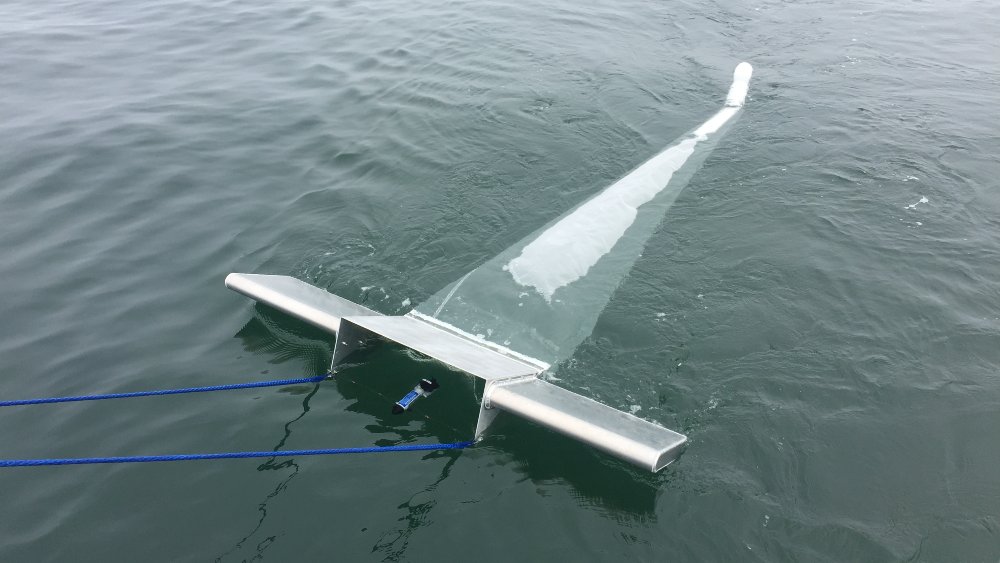
Manta trawl, Monterey Bay National Marine Sanctuary. Chad King / NOAA, public domain. Capture date unknown. Source
Plastic pieces smaller than five millimetres are generally called microplastics. Some result from fragmentation; others enter the environment already small. NOAA’s marine-microplastics database brings together observations from different places. Each sample covers a very small part of an immense ocean. Repeated samples, tied to a place and time, gradually help bridge that difference in scale. [8]
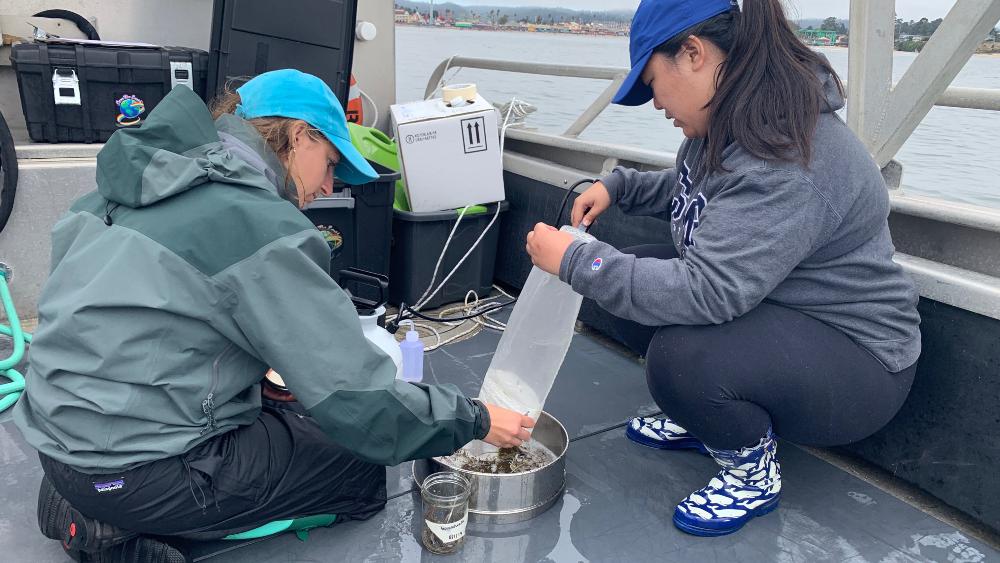
Recovering samples from the trawl’s cod end. Chad King / NOAA, public domain. Capture date unknown. Source
Watching someone recover material from a net makes clear that a map’s pattern is not an answer that simply appeared. People go to sea, separate samples and compare records. Making the movement visible depends on the work of establishing what is there in the first place.
A destination can also lie below the surface
A separate Monterey Bay study examined seawater from depths of five to 1,000 metres and particle-feeding animals. Published in 2019, it found microplastics distributed through the water column and implicated biological transport. Depth adds another dimension to a map that first looks like a flat ocean surface. [9]A thinner surface distribution cannot automatically be read as the disappearance of the problem. Movement through the water, arrival at a shore and uptake by animals require different observations. A surface-drift film is an opening into those questions, rather than a picture that explains the entire ocean at once.
Small particles and nets without an owner
A fragment’s journey can intersect with an animal searching for food. NOAA documents plastic ingestion by organisms ranging from plankton and shellfish to fish, seabirds and marine mammals. Plastic can be taken in alongside food, or through prey that has already ingested it. Transport by water is only part of the story. [10]Larger objects have another kind of persistence. Lost or abandoned fishing gear may continue catching animals through “ghost fishing.” Synthetic nets and ropes can remain in the water, entangling wildlife or damaging habitat. A tool designed to obtain food can continue acting after the person managing it is gone. [11]
People working at sea are affected too. Lost gear can reduce fishing opportunities and create navigation hazards. Debris on beaches affects visitors and the communities responsible for those shores. Marine plastic connects to fishing, tourism and everyday coastal work, rather than fitting neatly inside one remote environmental category. [12]
Removing what is there, changing what arrives next
Removing debris from a beach or the sea addresses material already present. If new material continues entering, that work continues. Following the map back toward its origins returns us to questions on land: where something was used, and where it passed out of a managed system.UNEP’s Turning off the Tap report combines reduced unnecessary use with reuse, recycling and changes in materials and design. Collection matters, as do products that can be used repeatedly or recycled in the market where they are sold. Focusing only on the final person discarding an item overlooks decisions made when it was designed, manufactured and distributed. [13]
The pattern spreading from Japan’s coast changes as time passes across the Pacific. Thinking about its destinations is also a way to reconsider what we choose, keep using and eventually let go. The coastline is not the end of everyday life’s reach. Beyond it, the things we send out continue their time in the world.
Data and representation
Four official CSV releases, each with 61 timestamps. Origin coordinates come from the initial data row. Marks represent supplied one-degree sample positions, not inferred cell boundaries.The provider omits probabilities below 0.00025; values are not renormalised. The displayed sum is reported. A fixed power-0.4 colour transfer makes low probabilities easier to distinguish without changing their values. All origins and times use 0–1%; values above 1% saturate.
The release season is January–February. Observation period and last update of the currently served model remain unconfirmed. Elapsed model time is not a forecast for a named calendar year.
Plastic Adrift / Erik van Sebille et al., CC BY 3.0. Coordinates converted and visualised by SORAH. Not an estimate of actual litter mass accounting for sinking, beaching or fragmentation. The same data and definitions are available in Data Scape.
Added and verified a North Atlantic release: 61 steps at two-month intervals, source origin and probability sums checked. Releases are not summed or renormalised. Dispersal may extend beyond the view. Videos show successive model steps without inventing particle tracks.
Sources
- UNEP · Informal Heads of Delegation meeting, 27–30 September 2026
- UNEP · Intergovernmental Negotiating Committee on Plastic Pollution
- NOAA · What is marine debris?
- NOAA · What is the Great Pacific Garbage Patch?
- van Sebille et al. · Origin, dynamics and evolution of ocean garbage patches (2012)
- NOAA AOML · Global Drifter Program
- NOAA · Microplastics, Monterey Bay National Marine Sanctuary
- NOAA NCEI · Marine Microplastics
- Choy et al. · Vertical distribution and biological transport of marine microplastics (2019)
- NOAA Marine Debris Program · Ingestion
- NOAA · Marine Debris: Derelict Fishing Gear
- NOAA · What are the impacts of marine debris?
- UNEP · Turning off the Tap (2023)
Author
SORAH Editorial
October 8, 2026