Mount Fuji is a symbol of Japan and one of the world’s most iconic mountains. Monthly snow observations, visibility records and 132 first-snowcap dates help us look closer.
Mount Fuji is a symbol of Japan and one of the world’s most iconic mountains. When is the best time to see it crowned with white snow? Monthly snow observations, visibility records and 132 first-snowcap dates help us look closer.
Mount Fuji has long inspired art and pilgrimage; UNESCO describes its international recognition as an icon of Japan.[10] The familiar image of Mount Fuji is a white-capped mountain beneath a blue sky. That view is seasonal. Snow falls, remains and disappears; even a snowy mountain can be hidden by cloud. Finding a white Mount Fuji means considering two different questions: when the mountain is white, and when it can be seen.
A mountain of contour lines, with seasonal snow above it
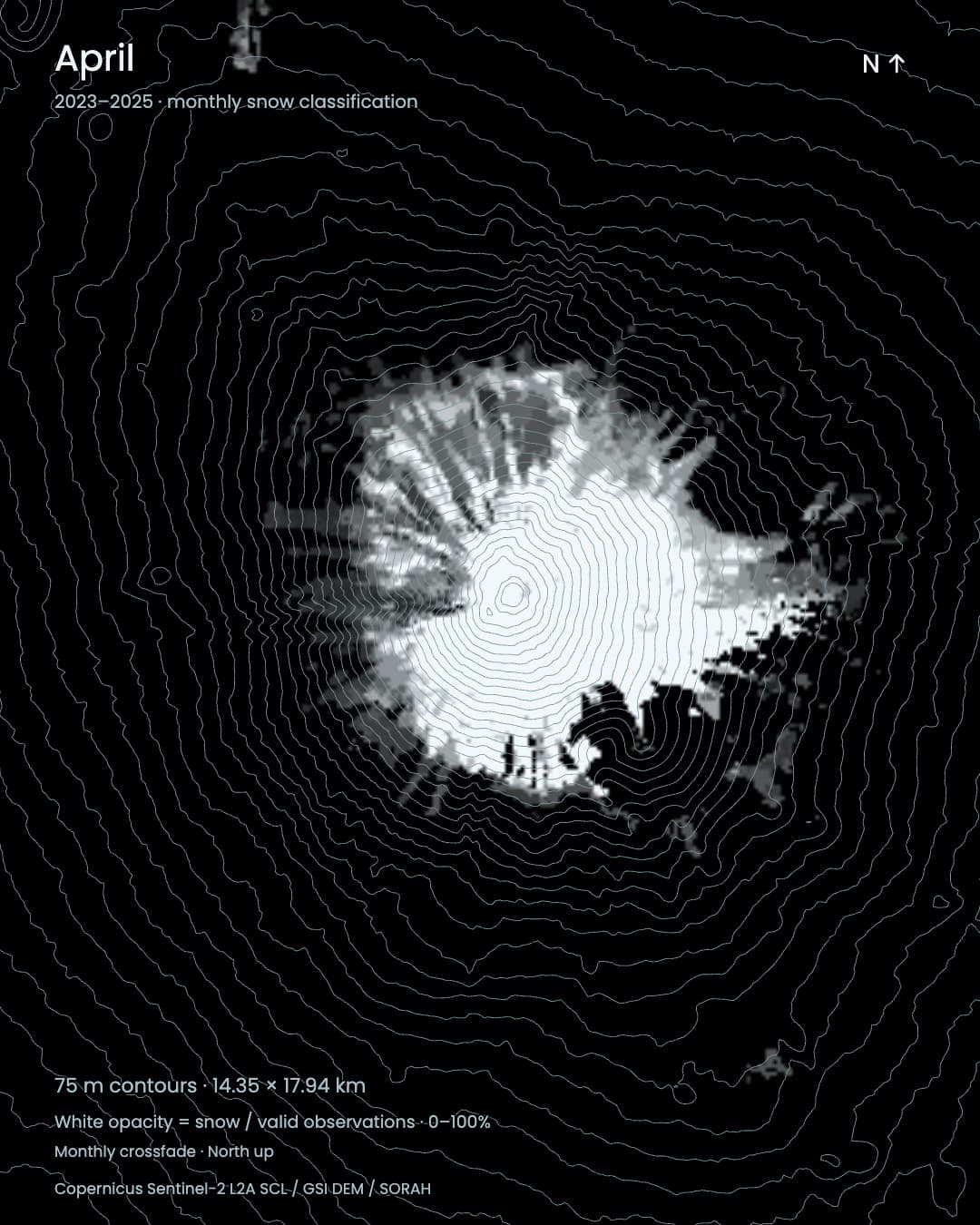
The fixed, north-up overhead view uses elevation contours at 75 m intervals, derived from the Geospatial Information Authority of Japan’s elevation data. Over them, monthly snow-classification fractions from satellite imagery in 2023–2025 show how the white area changes. Snow spreads into spring and largely retreats in summer. Among the selected observations, March had the highest snow-classified fraction of valid pixels above 2,000 m.[4][6]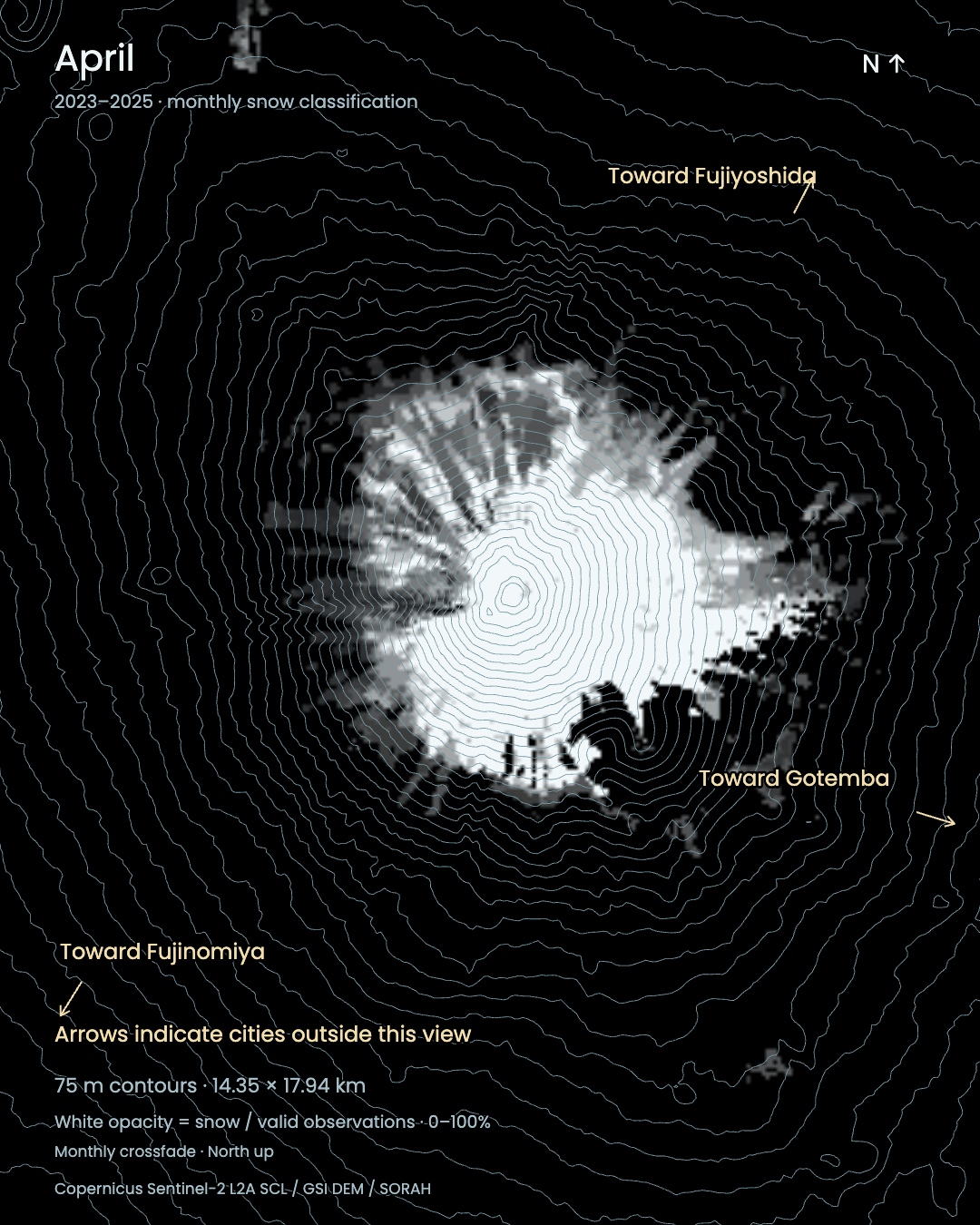
April snow-classification fraction, 2023–2025, over 75 m elevation contours. This is not snow depth. Arrows point toward Fujiyoshida, Gotemba and Fujinomiya, using city-hall coordinates. Their urban centres are outside this view; labels do not mark within-frame locations.[11][12][13]
Cold midwinter conditions alone do not explain the seasonal pattern. The Fuji Sabo Office describes how low-pressure systems passing south of Honshu bring spring snow to Mount Fuji. As towns begin to warm, the mountain can still carry extensive snow.[9]
For a clear, white Fuji, consider January or February mornings
Fuji City records mountain visibility at fixed times each day. In the 1991–2025 tables, the proportion of 8 a.m. observations in which the whole mountain was visible was 61.7% in December, 60.0% in January and 52.6% in February. March was 40.7%; July was 9.9%. Visibility has a strong seasonal pattern.[8]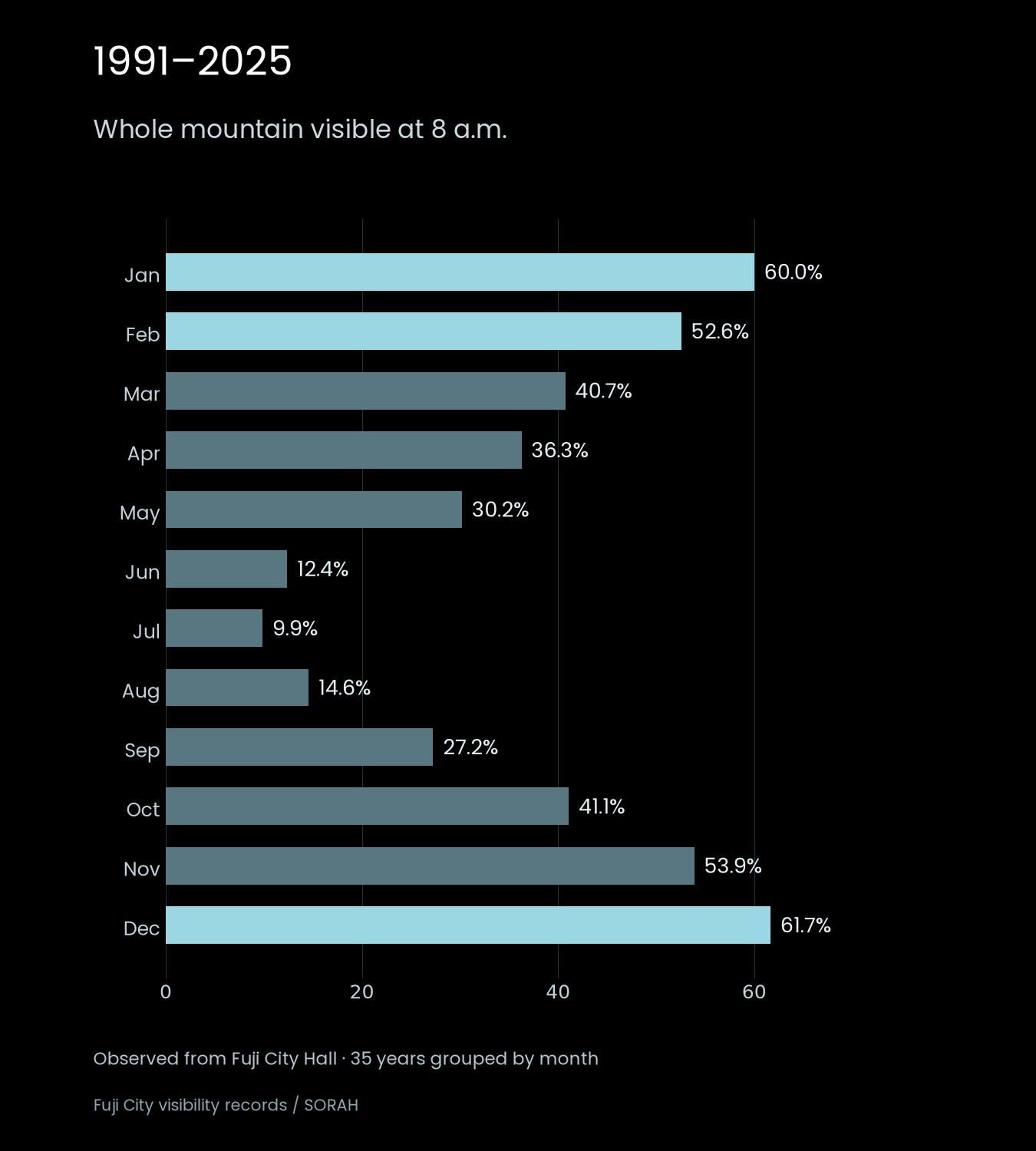
Days with the whole mountain visible at 8 a.m., divided by total observation days for each calendar month, 1991–2025. This measures visibility, not the presence of snow.[8]
Taken together with the snow observations, this suggests January and February mornings as promising candidates for seeing both snow and a clear mountain. December is also attractive if visibility is the priority. March may appeal to those seeking extensive snow cover, but the whole mountain was visible on a smaller proportion of mornings than in winter. This is a suggestion based on Fuji City’s viewpoint and a limited satellite sample, not a guarantee for every year or viewing direction.
The return of the white summit is not fixed to a date
The 132 first-snowcap observations made from Kofu between 1894 and 2025 vary considerably. Comparing the earliest 30 years, 1894–1923, with the most recent 30 years, 1996–2025, gives a mean first-snowcap date 11.7 days later. The recorded dates were November 7 in 2024 and October 23 in 2025.[1]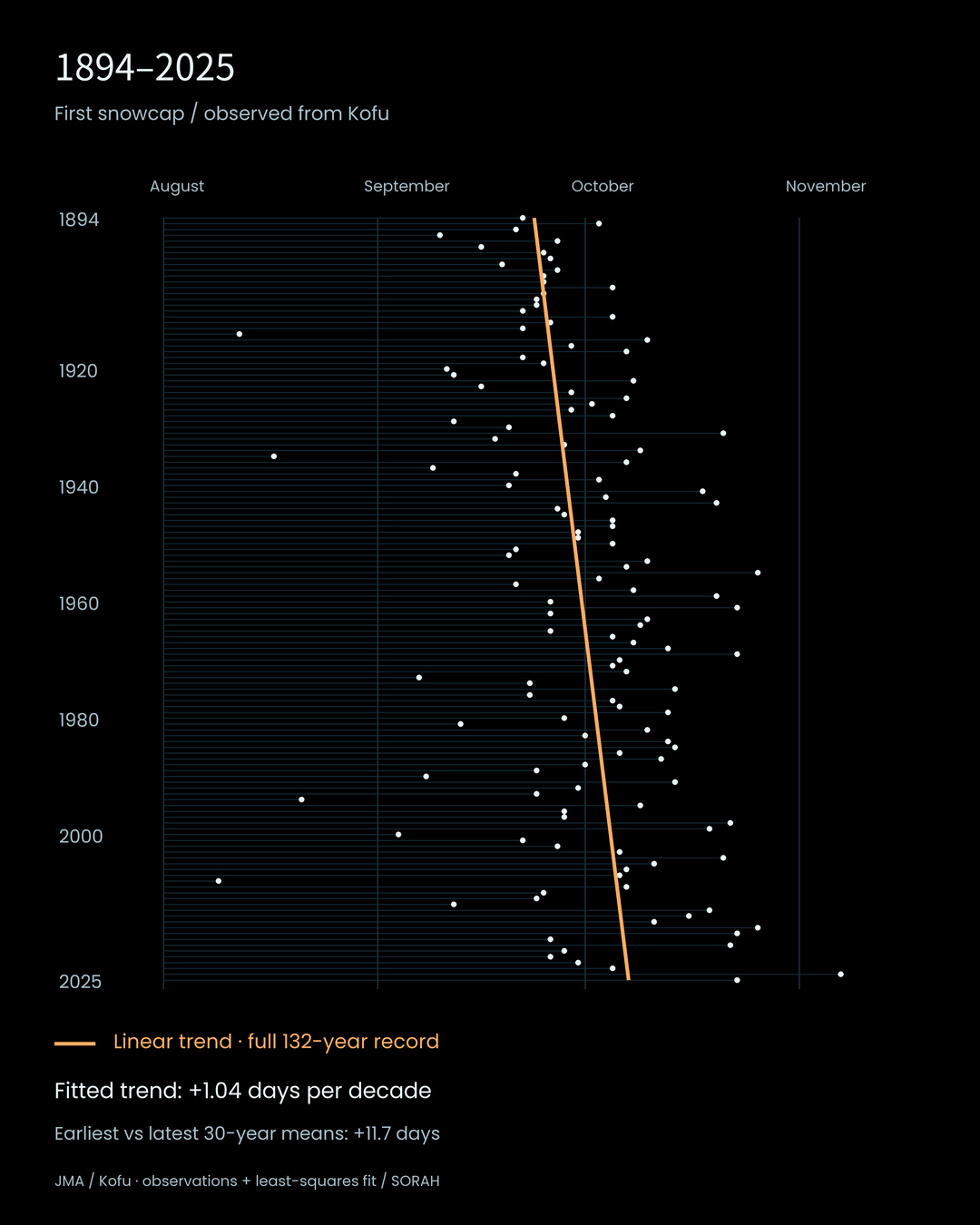
White dots: annual observations. Orange: least-squares linear fit to all 132 years, +1.04 days per decade, with dates expressed as days after August 1. This differs from the 11.7-day comparison of the earliest and latest 30-year means and does not imply uniform change every year.[1]
A first-snowcap date records when the mountain first appeared white from Kofu. It is different from the amount of snow accumulated through winter or remaining in spring. The changing return date and the extent of snow cover are separate observations. The observation-method change from 2026 also needs to be distinguished from the historical series.[1][2]
A familiar landscape is shaped by each year’s snow and sky. Following the months across the contour lines turns that familiar view into a more specific question: on what morning, and in which season, might we see it next?
Note · Data and comparisons The snow layer samples three scenes with low scene-level cloud cover for each month of each year in 2023–2025, 108 scenes in total. SCL class 11 represents snow/ice; classes 2, 4, 5, 6 and 11 count as valid observations. Pixels with fewer than three valid observations are not displayed. This clear-sky-biased sample is not a 30-year climate mean, snow depth or a daily snow probability. Visibility comes from 8 a.m. observations at Fuji City Hall in 1991–2025. Snow and visibility fractions are not simultaneous probabilities and have not been multiplied. First-snowcap dates are not direct measures of snowfall amount or temperature.[1][4][8]
Data Scape
Explore this data in Data ScapeSources
- 甲府地方気象台・初冠雪観測記録(2026.09.15)
- 甲府地方気象台・平年日と観測方法変更
- 気象庁・利用条件(PDL 1.0)
- Copernicus Sentinel-2 L2A・シーン分類(雪・氷=11)
- Earth Search・Sentinel-2 L2A(108シーンのIDをデータ確認票に収録)
- 国土地理院・標高タイルの詳細仕様
- Sentinel-2 Cloud-Optimized GeoTIFFs・提供と利用条件
- 富士市・富士山観測の記録(1991〜2025年、各年月別の原表)
- 国土交通省・富士砂防事務所「富士山の雪」
- UNESCO · Fujisan: internationally recognized icon of Japan
- 富士吉田市 · 土地・気象(市庁舎の位置)
- 御殿場市 · 市勢要覧(市役所の所在地)
- 富士宮市 · 気象観測(市庁舎の緯度・経度)
Author
SORAH Editorial
October 2, 2026