Published on 06/October/2026 · Climate
By 2050, the conditions behind a cup could change.
By SORAH Editorial
Land in the highest suitability class for rainfed Arabica could shrink by 53.7% worldwide around 2050. One climate scenario puts a number on a change facing both coffee trees and the people who grow them.
Land in the highest suitability class for rainfed Arabica could shrink by 53.7% worldwide around 2050. One climate scenario puts a number on a change facing both coffee trees and the people who grow them.
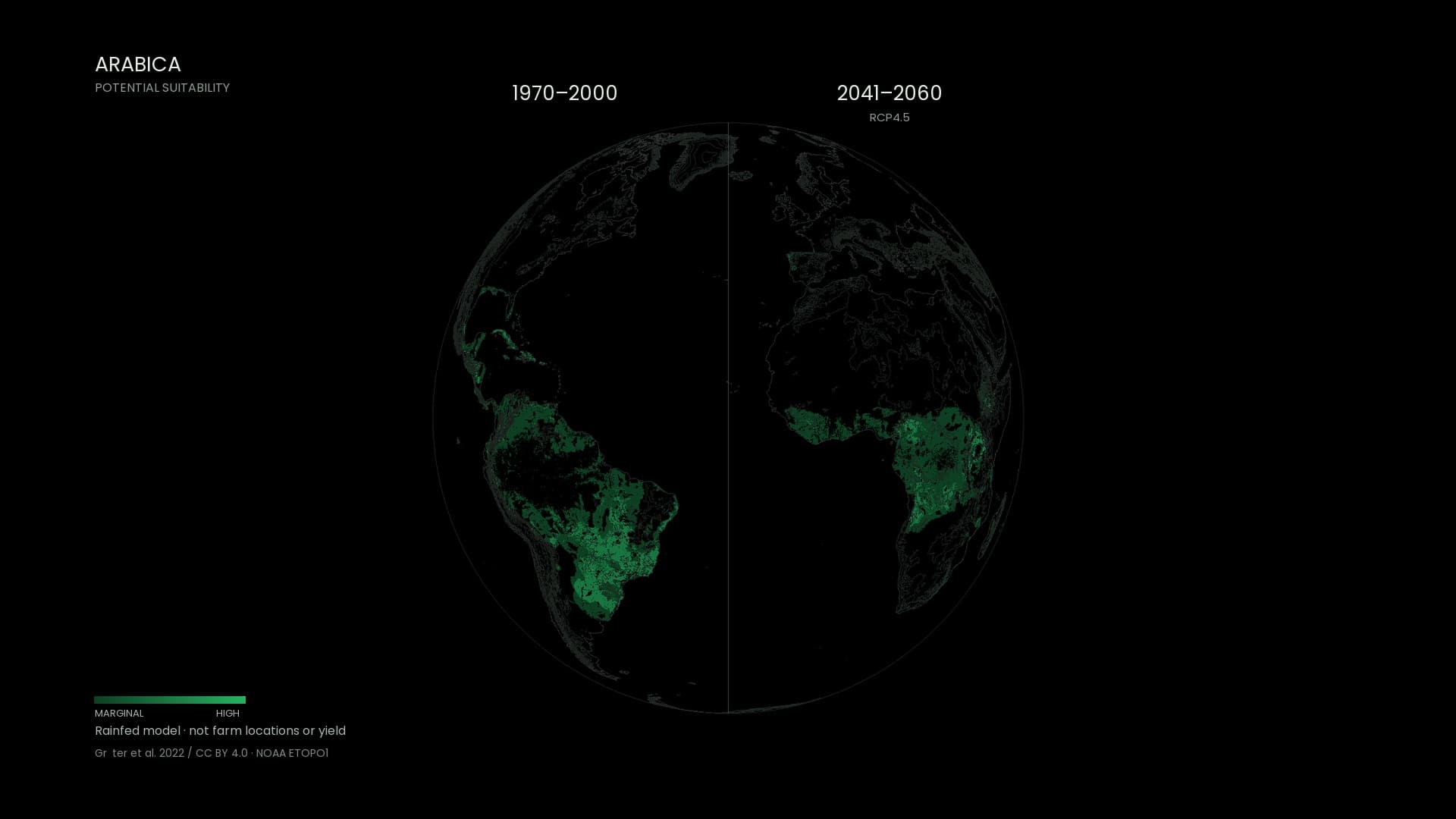
The estimate comes from the RCP4.5 scenario in a study published in 2022, comparing 1970–2000 with 2041–2060. It assesses climate, land and soil. The percentage concerns the highest suitability class; it does not predict that coffee harvests will halve. [1]
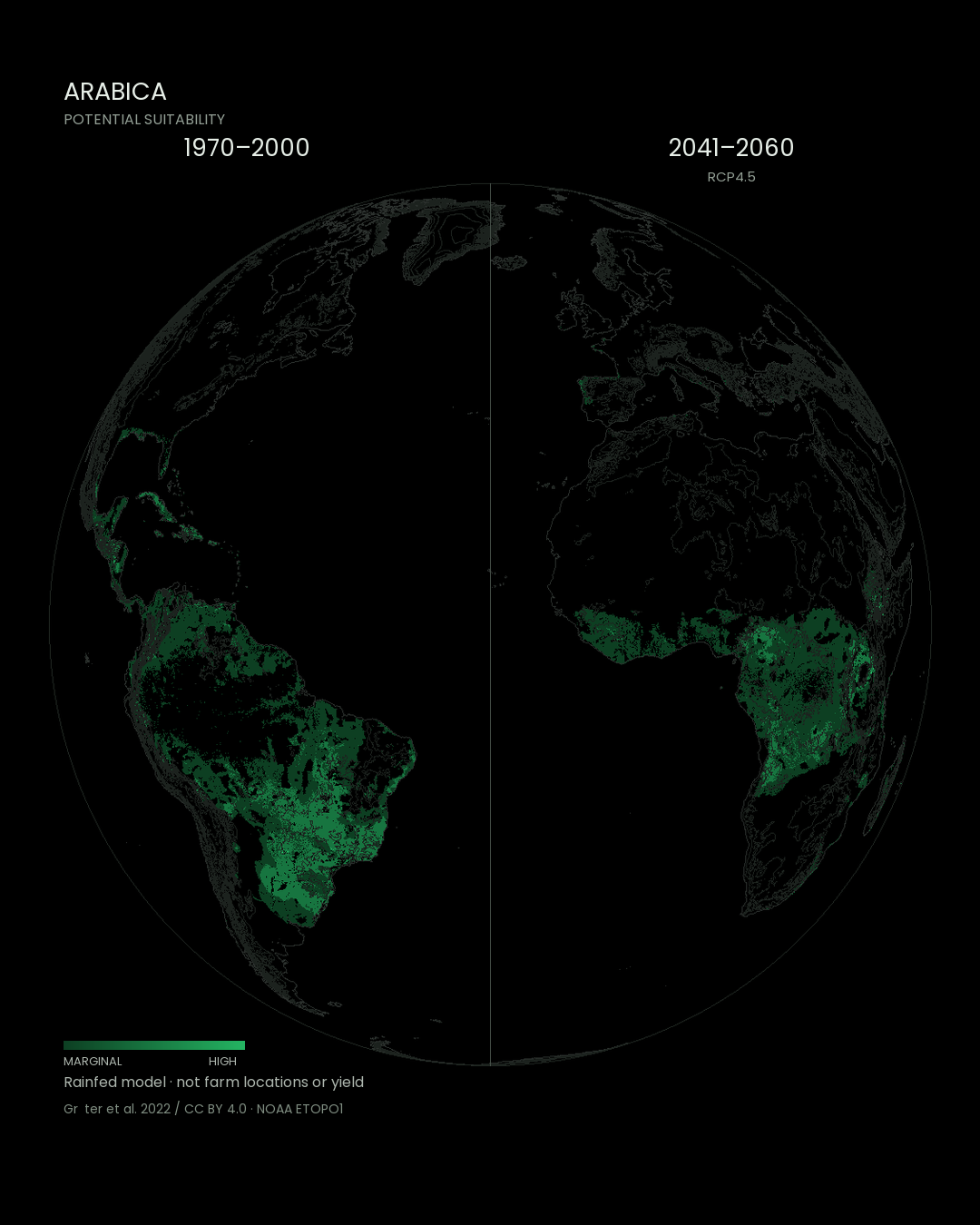
Potential rainfed Arabica suitability. Left: 1970–2000; right: 2041–2060, RCP4.5. Stronger green indicates higher suitability. Grüter et al. 2022 / CC BY 4.0 · NOAA ETOPO1.
A familiar origin, changing conditions
Rising mean annual temperature reduces suitability across many producing regions. Elsewhere, a long dry season, excessive rain or unsuitable soils can set the limit. These constraints combine differently from place to place. Warmer conditions do not make every landscape easier to cultivate. [1]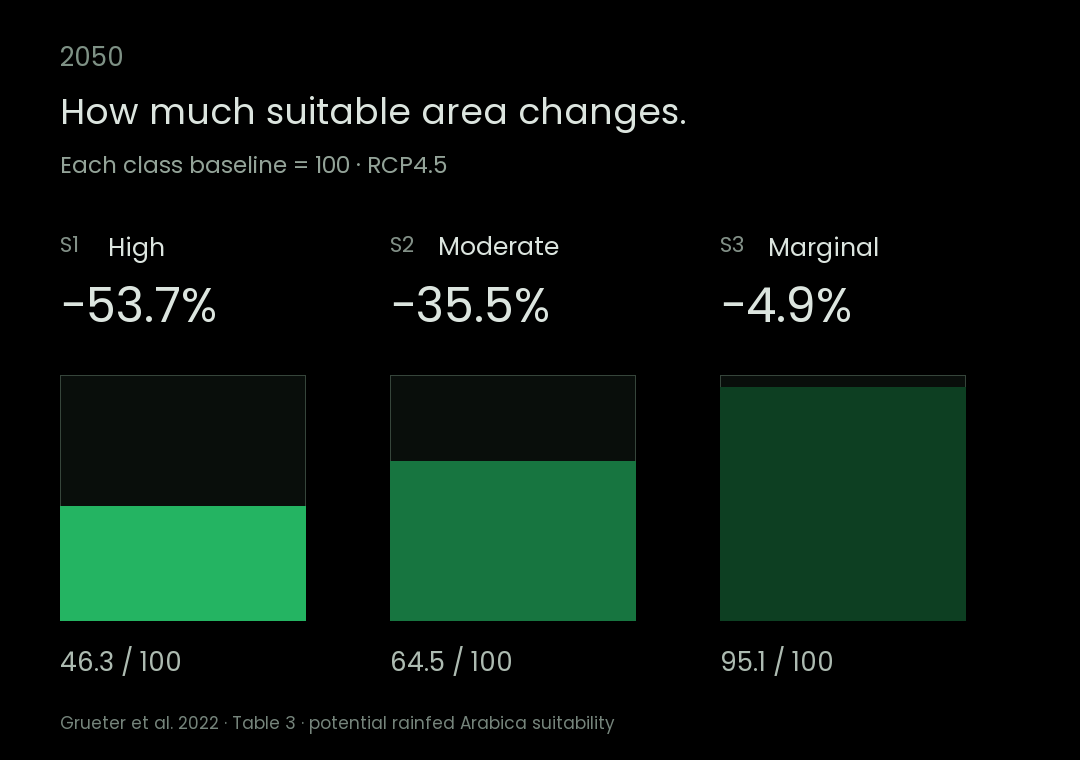
Each class is independently normalised to its baseline area of 100. Green area shows the future proportion; negative percentages show area loss. Classes have different absolute areas. This does not measure farm area or harvests. Grüter et al. 2022, Table 3 / RCP4.5.
Some higher elevations and latitudes may benefit where cold has limited cultivation. But potential new growing areas already have forests, ecosystems and other land uses. A patch of emerging suitability is not a recommendation to create a plantation.
Choosing a bean begins with choosing a tree
This map concerns Arabica. In 2023, World Coffee Research reported that Robusta, the other major cultivated coffee, accounted for about 40% of global production. Species and varieties differ in elevation suitability, disease resistance and yield potential. Variety catalogs collect these practical considerations for growers. [2] [3]Before a cup reaches a table, cherries must be grown, picked, sorted and processed. The hands in this photograph bring the globe’s green back to a landscape of work and livelihoods.
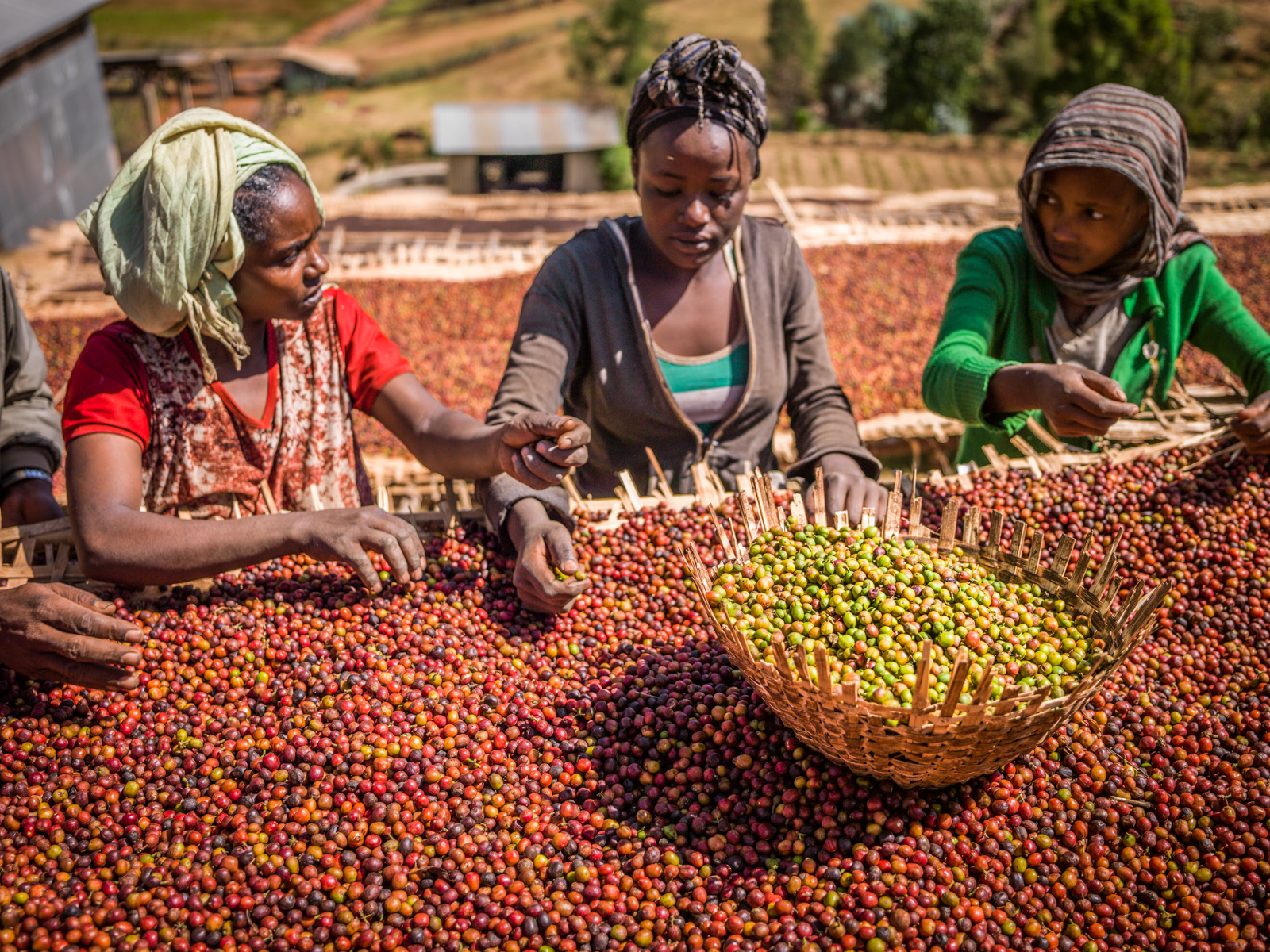
Sorting coffee cherries near Hawassa, Ethiopia, 26 January 2017. A record of work in coffee production. Niels Van Iperen · CC BY-SA 4.0
A tree planted for the decades ahead
Coffee is a long-lived crop. A variety selected today must grow through years of changing rain and temperature. Replanting takes time and investment; processing facilities and transport routes also connect production to a place. [1]The 2050 map asks more than where the next coffee region might emerge. What can growers plant in today’s regions, and what conditions should they prepare for? The future of an everyday cup rests on those long decisions.
Data and interpretation
Author-released results from Grüter et al. (2022). Potential rainfed Arabica suitability: 1970–2000 baseline and 2041–2060 under RCP4.5, based on 14 global climate models. Original S1, S2, S3 and N classes are retained; the 30-arcsecond source is sampled at 5 arcminutes with nearest neighbours. Opacity expresses an ordered class, not continuous yield or probability. The explorer distinguishes unclassified cells from unsuitable ones. White lines are fixed NOAA ETOPO1 elevation contours. Rotation changes the viewpoint, not climate time.
The display does not map existing farms, yields, Robusta or the effects of management adaptation. No global area-loss percentage is calculated from these display samples. It is not a farm-level planting assessment.
Sources
Author
SORAH Editorial
October 6, 2026