From the coast of West Africa to the Caribbean, air connects places across the ocean. Dust fields from September 2026 open a view onto the relationships between desert, sea and distant forest.
From the coast of West Africa to the Caribbean, air connects places across the ocean. Dust fields from September 2026 open a view onto the relationships between desert, sea and distant forest.
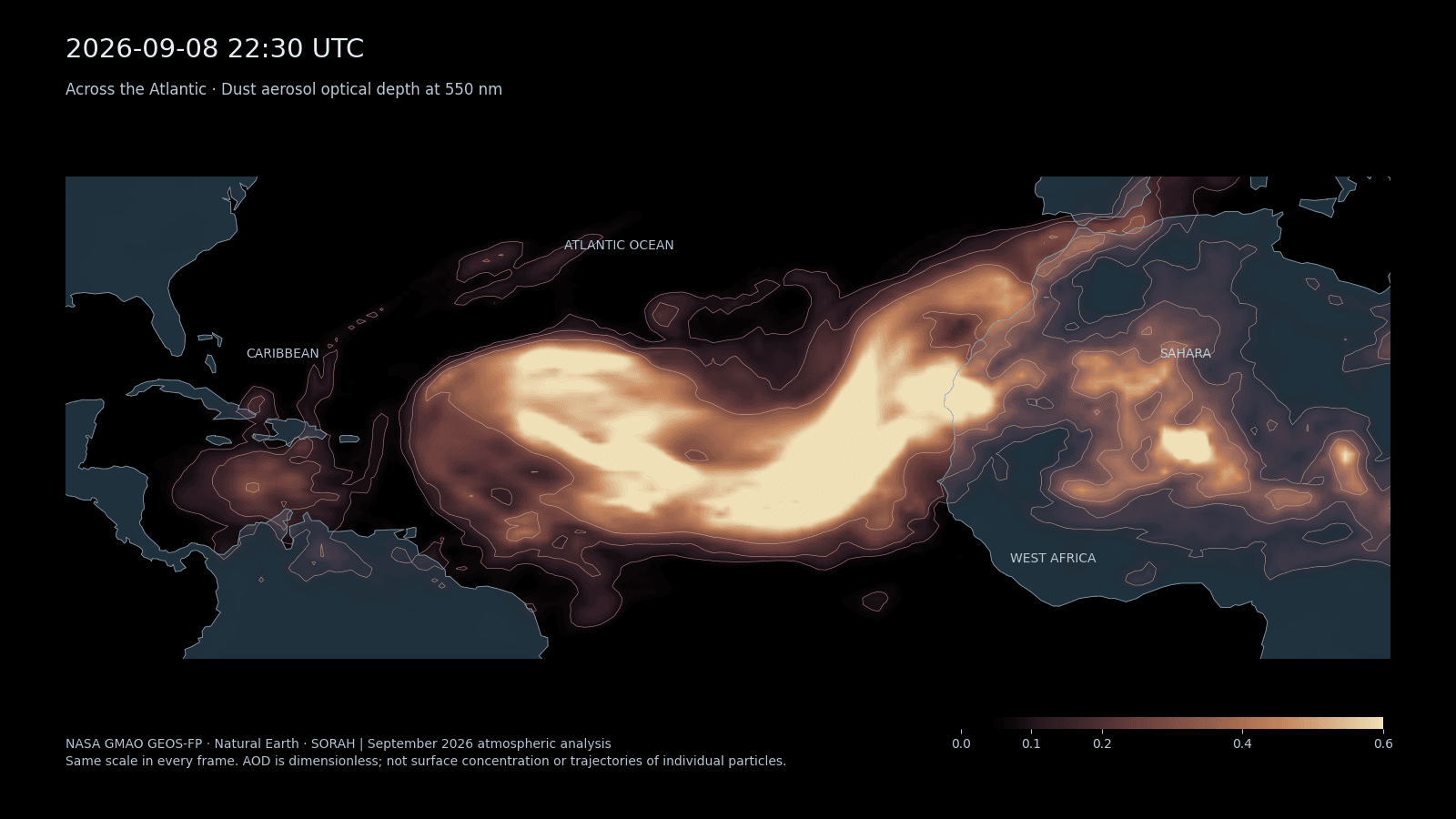
48 analysis fields at six-hour intervals, 22:30 UTC 2 September–16:30 UTC 14 September 2026. Dust AOD at 550 nm describes light attenuation through the atmospheric column. Fixed scale 0–0.6; higher values share the upper color. Not surface concentration or deposition.
Something from land, above the sea
Dust fields extend offshore from West Africa. The Caribbean lies to the west, North America to the north. As dates advance, changing patterns connect shores within the same frame. NASA's GEOS-FP atmospheric analyses show the distribution from 2–14 September 2026. Color represents a measure related to how dust attenuates light through the atmospheric column, not the tracked journeys of individual grains.[1]Desert air and distant weather
Dry, warm air carrying Saharan dust spreads over the Atlantic from late spring through early fall. The US National Oceanic and Atmospheric Administration monitors this Saharan Air Layer by satellite: its warmth, dryness and strong winds can suppress tropical cyclone development.[2] Dust patterns provide one clue to weather conditions. They cannot establish whether a hurricane will form or where it will go. Temperature, moisture and winds matter too. Behind the particles is the air carrying them.[2] After crossing the ocean, dust can affect visibility and air quality. When a large plume reached Puerto Rico in June 2020, monitoring that combined satellite data with ground observations helped provide advance information to public-health agencies and doctors. Watching distant air can support preparations close to home.[4]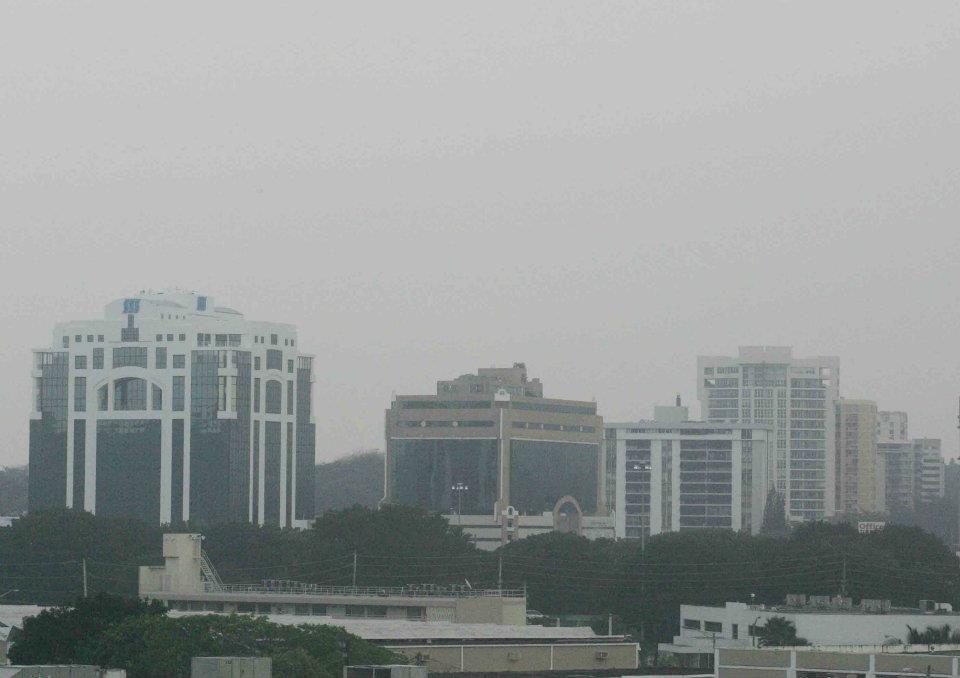
Saharan dust hazes the sky over Puerto Rico, photographed on 4 July 2014. An example of its effect on visibility, separate from the September 2026 visualization and the June 2020 case discussed above.
Gilbert 97 / Wikimedia Commons · CC BY-SA 3.0 · Original image, unaltered
Between desert and rainforest
Dust can leave the air through rainfall, carrying phosphorus that plants need. A NASA-led study used satellite observations from 2007–2013 to estimate Saharan dust and phosphorus transport to the Amazon. Chad's Bodélé Depression, an ancient lake bed, was identified as an important source of phosphorus-bearing material.[3] That is evidence from a separate, multi-year study. This September view neither measures delivery to the forest nor includes the Amazon, which lies south of the frame. It nevertheless gives a way to think about desert and rainforest as connected environments.A coastline along the way
The map separates land from sea. The atmosphere carries material across that boundary, diluting it, mixing it with other air and washing some of it down in rain. Seen between West Africa and the Caribbean, the Atlantic is both a distance and a place of transport. Looking above the coastlines reveals another geography of connection.Data / Sources
NASA GMAO GEOS-FP DUEXTTAU, dust AOD at 550 nm, retrieved 20 September 2026. Six-hour selections from a three-hour series; crop 90°W–20°E, 0–40°N. Bilinear spatial rendering without temporal interpolation. AOD alone does not determine exposure, deposition, individual origins or destinations.GEOS-FP / DUEXTTAU / 177 × 81 grid / 0.625° × 0.5° / uint16 × 0.0001, nodata 65535 / 48 frames, 6 h step / fixed range 0–0.6.
[1] NASA GMAO · GEOS-FP: https://gmao.gsfc.nasa.gov/gmao-products/geos-fp/ [2] NOAA · The Saharan Air Layer(2025-06-01): https://www.nesdis.noaa.gov/news/the-saharan-air-layer-what-it-why-does-noaa-track-it [3] NASA · Saharan dust and Amazon phosphorus(2015-02-22、観測2007–2013): https://www.nasa.gov/missions/calipso/nasa-satellite-reveals-how-much-saharan-dust-feeds-amazons-plants/ [4] NASA · Puerto Rico and Saharan dust impacts(2020): https://www.nasa.gov/missions/aqua/nasa-helps-puerto-rico-prepare-for-saharan-dust-impacts/
Author
SORAH Editorial
October 4, 2026