Published on 16/October/2026 · Nature
Biodiversity over 115 years: what remains of the life a landscape once supported?
By SORAH Editorial
Compare 1900 and 2015 through a global model of terrestrial biodiversity intactness.
A bird becomes harder to hear. An insect disappears from the edge of a field. Changes in biodiversity unfold through the abundance of familiar species as well as the disappearance of species altogether. A map of intactness asks how much of a place’s original biological community it can still support.
One landscape, two dates
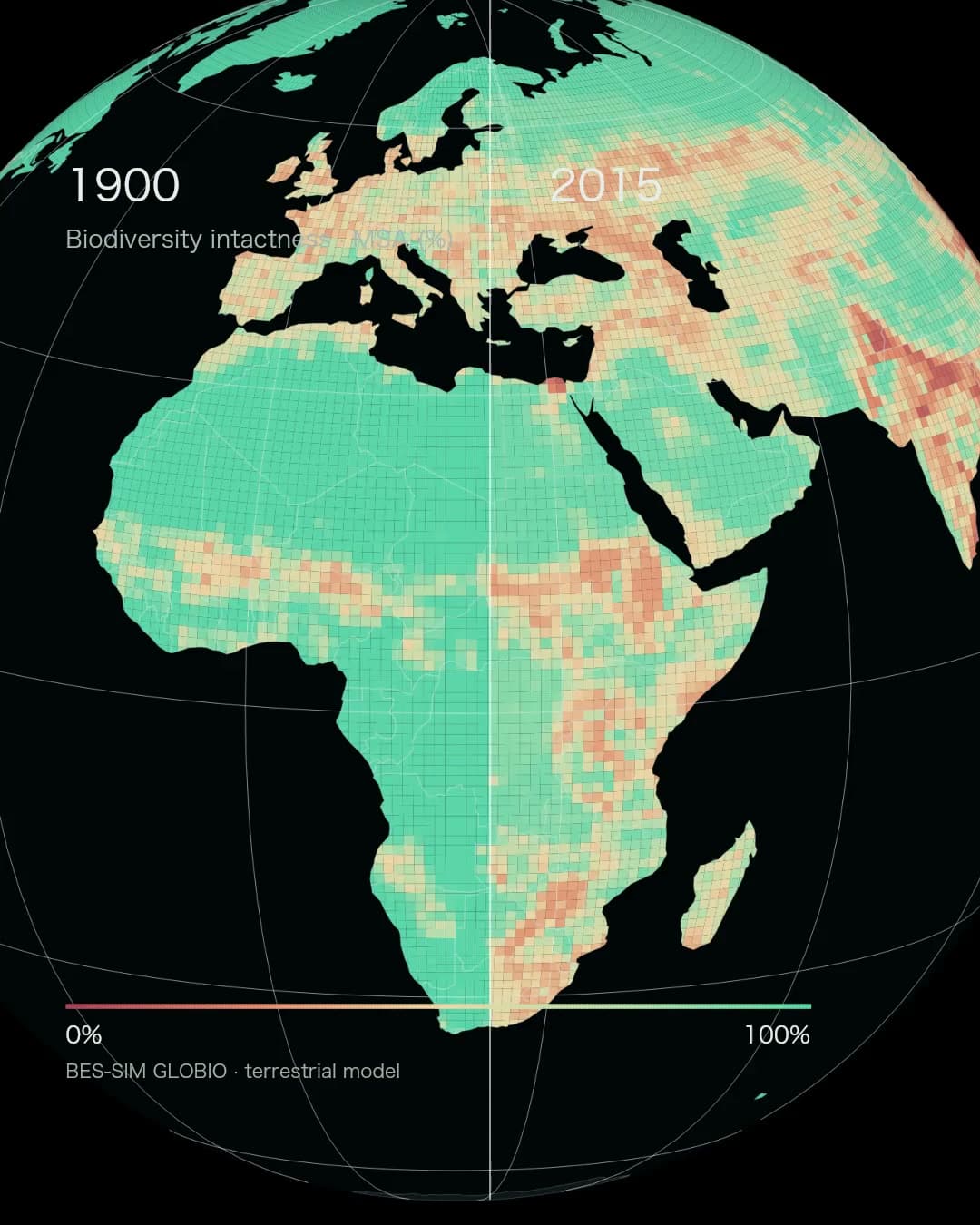
This map uses the GLOBIO contribution to BES-SIM, comparing model estimates for 1900 and 2015. Mean Species Abundance, or MSA, expresses the average abundance of originally present species relative to a near-natural reference. The same colour scale is applied to 18,972 land cells with values at both dates: mint at the high end, coral at the low end. BES-SIM GLOBIOPereira and colleagues’ 2024 Science study brought multiple models and indicators together to investigate long-term change. Species richness, intactness and ecosystem services provide different windows onto that change. Considering them together helps connect the survival of species with the abundance and ecological functions of their communities. Pereira et al., 2024
The same species list can conceal a changed community
Imagine a woodland where the familiar birds, insects and plants can still be found, but each has become less abundant. A list of species would retain the same names; the community would have changed. MSA focuses on the abundance of originally present species. Increases above the reference abundance are capped, limiting the ability of a few successful species to offset declines in others. GLOBIO’s definition of MSAThe choice of dates also matters. In many places, farming and settlement already had long histories by 1900. That year provides the starting point for this comparison. A low value at both dates invites questions about earlier changes; a large difference invites questions about the intervening 115 years. Present condition and the path towards it are two useful ways to read the map.
When the use of land changes
Converting forest to cropland or pasture rearranges the conditions in which organisms live. Shade, moisture, food and the distance between suitable habitats change. These transformations also produce food and materials for people. Read in that context, the map invites questions about what a landscape produces, what it retains and how it is managed. iDiv research summaryThe arrangement of habitat matters alongside its area. When continuous woodland becomes separated patches, the conditions for moving between feeding and breeding sites change. IPBES identifies land-use change, exploitation, climate change, pollution and invasive species among the direct drivers of biodiversity change. Investigating a particular place means bringing its management history and field observations into the picture. IPBES
A 1° cell spans roughly 111 km from north to south. It can contain settlements, farms, regrowing woodland and protected forest. Its broad pattern can guide a closer investigation: which land uses expanded, and how are the remaining habitats connected? These are questions that can be followed through local maps and records.
A fallen tree is also a habitat
In Białowieża Forest, spanning Poland and Belarus, old woodland includes standing and fallen dead wood that supports fungi and wood-dependent invertebrates. Its conservation value resides in communities and the conditions that sustain them. UNESCO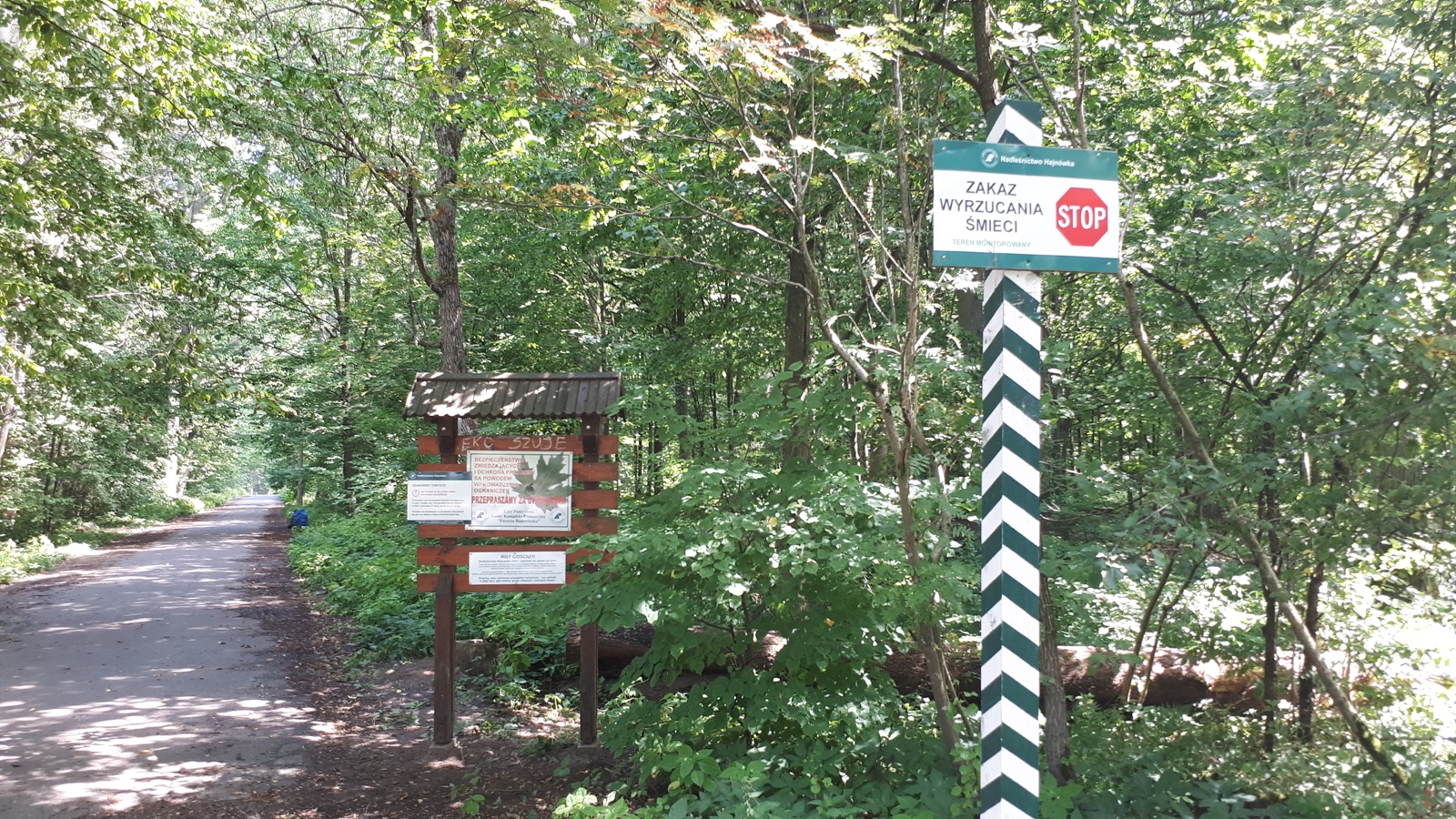
Białowieża Forest, Poland. 28 July 2020. Rakoon · CC0 1.0 · Source
A global cell is a starting point for looking closer: at the woodland, grassland and wet ground within it. Combining broad model patterns with field counts and management records can make the next conservation question more specific.
Life on the land that produces food
Conservation also involves working landscapes. Pollinating insects, organisms that control crop pests and soil life that cycles nutrients contribute to production. Target 10 of the global biodiversity framework calls for sustainable management of agriculture, forestry and other production systems, making use of these biological contributions. Convention on Biological DiversityPossible practices depend on the crop, local conditions and the people doing the work. Diversification and soil management need to be considered alongside livelihoods. Reading the map with farmland in mind opens a practical question: which forms of management can sustain both native life and the people producing food?
Restoring an area, and the conditions within it
The framework’s Target 2 calls for at least 30% of degraded ecosystems to be under effective restoration by 2030, supporting biodiversity, ecosystem functions, integrity and connectivity. Target 2 At a local scale, progress becomes a set of observations: plants establishing, animals breeding, and movement between habitats becoming possible. A historical model supplies the longer context. Repeated field surveys can follow what happens within that context, and help identify the conditions that need attention.From a lost quantity to conditions worth keeping
Where could habitat persist? Which features of working farmland could support native life? The comparison opens a practical question about how land that sustains our lives can continue to sustain other lives, too.Data and representation
BES-SIM GLOBIO, Schipper & Alkemade (2023), DOI:10.25829/r7bt92, CC BY 4.0. LUCC historical model estimates for terrestrial ecosystems in 1900 and 2015.MSA: mean relative abundance of originally present species against a near-natural reference, shown as 0–100%. Native 1° cells; 18,972 valid at both dates. Missing values remain missing.
The film shows 1900 on the left and 2015 on the right, separated by a thin line. Both maps share the projection, scale and camera transform. The assessment covers terrestrial communities.
Change view: 2015 minus 1900, in percentage points. Natural Earth background geography is public domain.
Sources
Author
SORAH Editorial
October 16, 2026