
Published on 07/October/2026 · Society
Ukraine: the power and lives behind the lights.
By SORAH Editorial
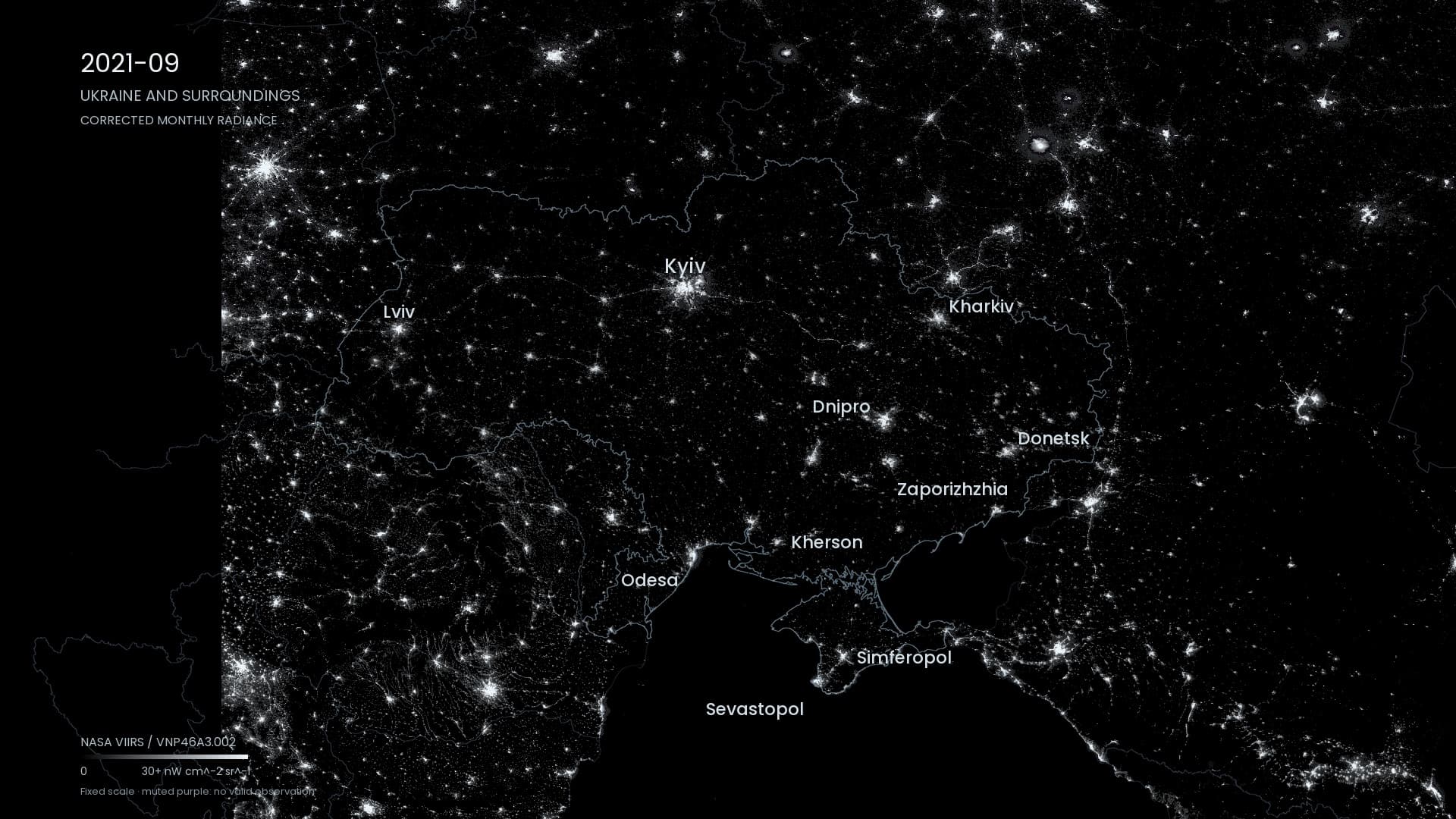
From September 2021 to autumn 2023, begin with Ukraine’s lights before the full-scale invasion of 24 February 2022, and follow their changes alongside the work needed to keep electricity reaching people.
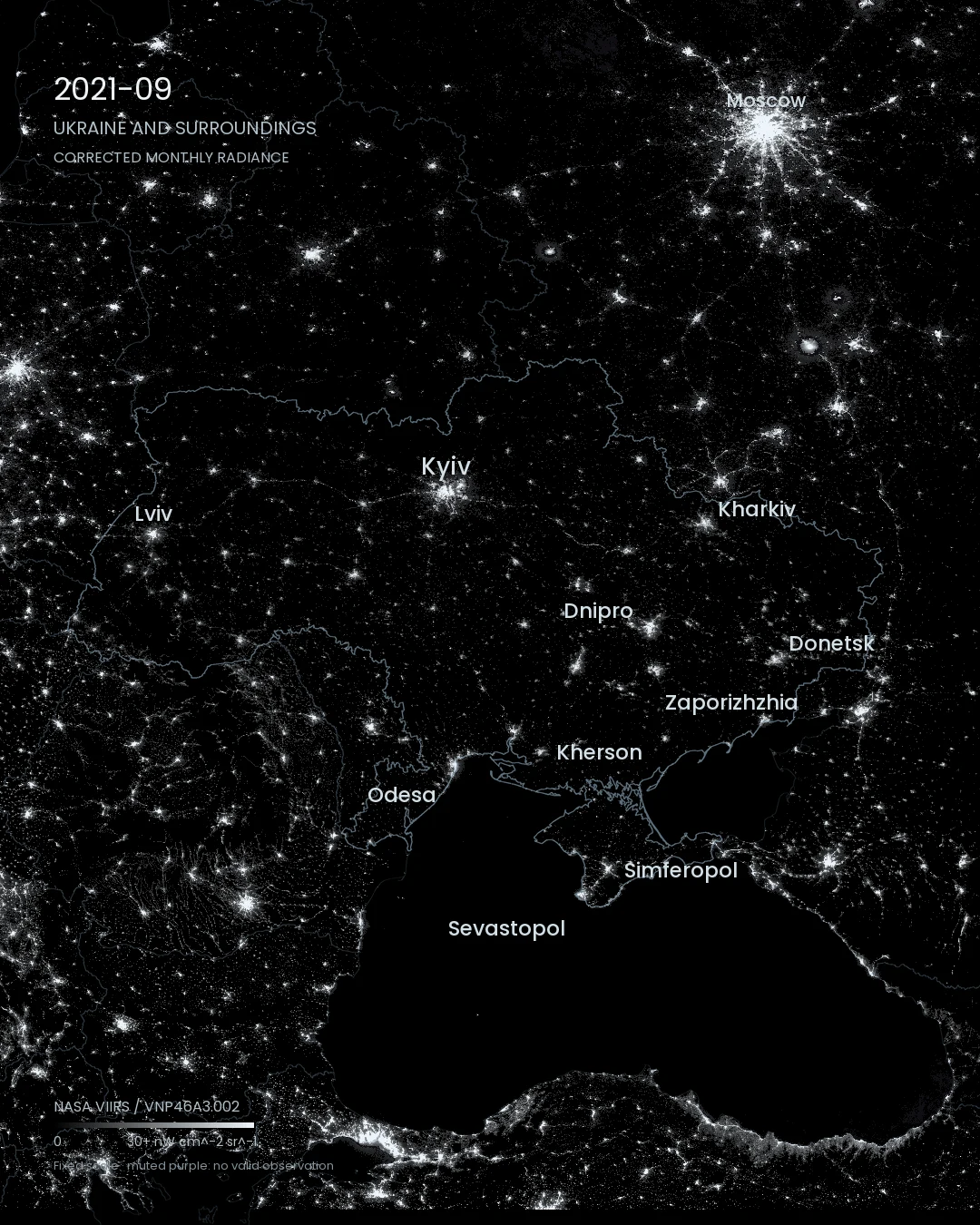
Seven selected monthly composites show Ukraine and its surroundings in one fixed view and scale, including Crimea. September 2021, before the full-scale invasion, is followed by August, September and October from 2022 and 2023 after excluding months with pronounced northern gaps or inconsistent observation coverage. Each view is held for 2.8 seconds; calendar time does not advance at a uniform rate. All 24 months of 2022–2023 remain available in Data Scape.
Explore each month in Data Scape
Still: September 2021, before the full-scale invasion. Video: this baseline followed by August, September and October in 2022 and 2023; seven views held 2.8 seconds each, 19.6 seconds total. NASA VNP46A3.002. Muted purple: no valid observation.
Spring 2022: the war around the capital
Russia launched its full-scale invasion of Ukraine on 24 February 2022. Fighting reached the outskirts of Kyiv, damaging homes and the infrastructure that sustained daily life. Russian forces withdrew from Bucha, northwest of the capital, at the end of March; evidence of violence against civilians during the occupation then emerged. As people began returning to parts of the capital region, fighting continued elsewhere, including in the east.[4]Images released by NASA in June 2022 show light returning to some of Kyiv’s outskirts in May after a decline in March. NASA also reported continued losses of light in eastern Ukraine. The recovery of power and the return of residents in some places coexisted with continuing conflict elsewhere.[2]
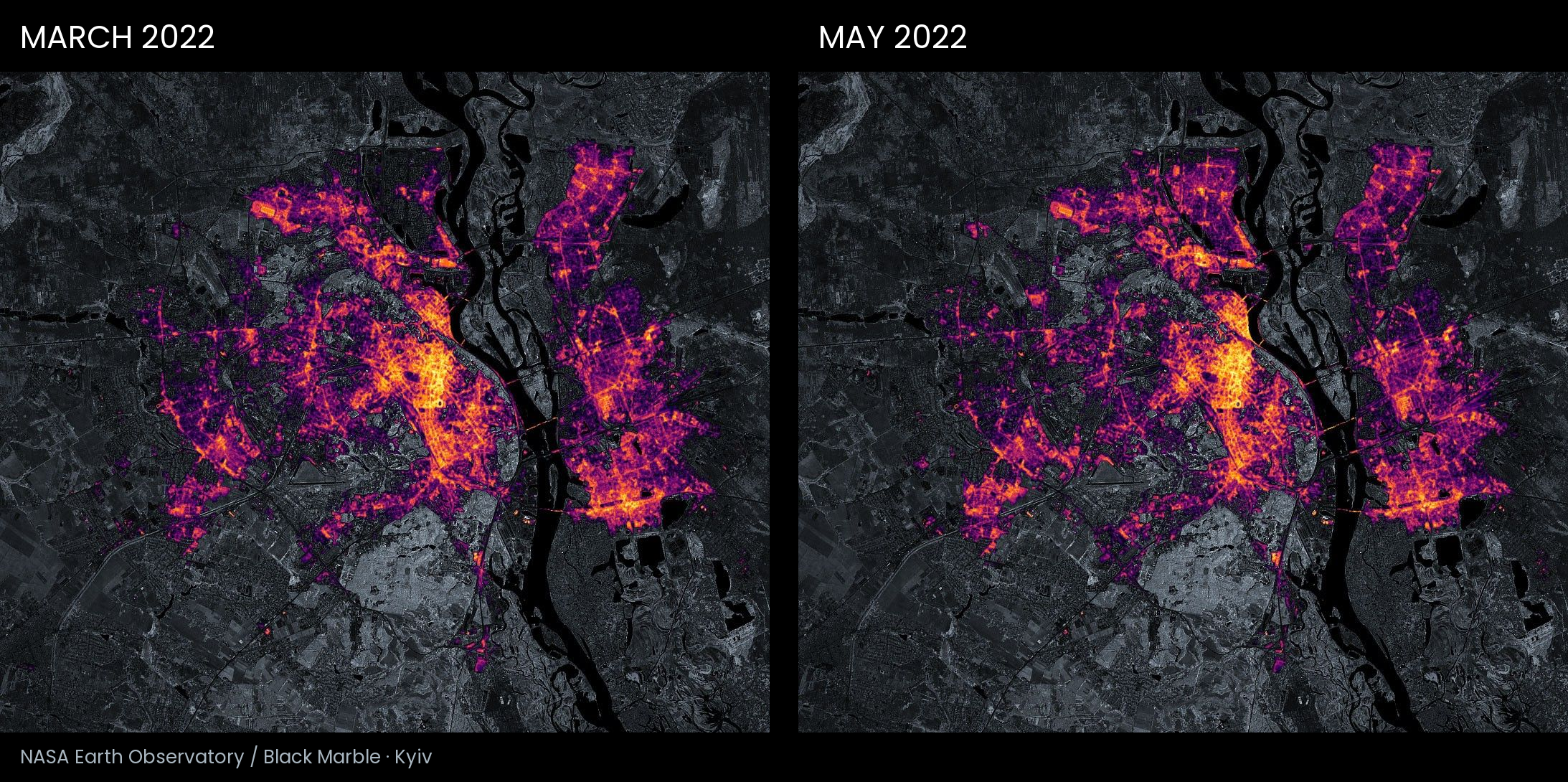
Kyiv region, March and May 2022. NASA images of the same area are aligned here. Yellow and orange indicate stronger nighttime light; purple indicates weaker light. NASA Earth Observatory / Joshua Stevens; Black Marble data: Ranjay Shrestha, NASA GSFC. Source
Note · These spring images were published separately by NASA and use a different presentation from the seven-view video. Darkness can reflect outages, displacement and deliberate reductions in lighting.
Attacks on power reached beyond the front line
Damage to electricity infrastructure extended beyond the places where ground battles were being fought. The UN Human Rights Office reported that Russian missile strikes on 10 October 2022 damaged or destroyed at least 12 energy facilities across eight regions. Damage to power stations and lines can interrupt the electricity needed for water and heating in cities far from the front.[5]The IEA’s 2024 report states that around half of Ukraine’s generation capacity was occupied by Russian forces, destroyed or damaged during 2022–2023. The occupation of the Zaporizhzhia nuclear plant alone removed 6 GW from Ukraine’s available capacity. Attacks in March–May 2024 then took out another 9 GW, mainly thermal and hydropower facilities.[3]
Note · Each monthly image combines observations within that month. It is not a before-and-after comparison of 10 October. The 2024 infrastructure losses lie outside the video’s period.
Electricity consumption fell by almost a third in one year
How much less electricity was used? The UN Statistics Division reports annual consumption of 124.3 TWh in 2021 and 85.3 TWh in 2022: a decline of about 39.1 TWh, or 31.4%. Consumption rose slightly to 87.2 TWh in 2023, but remained about 29.9% below 2021.[6]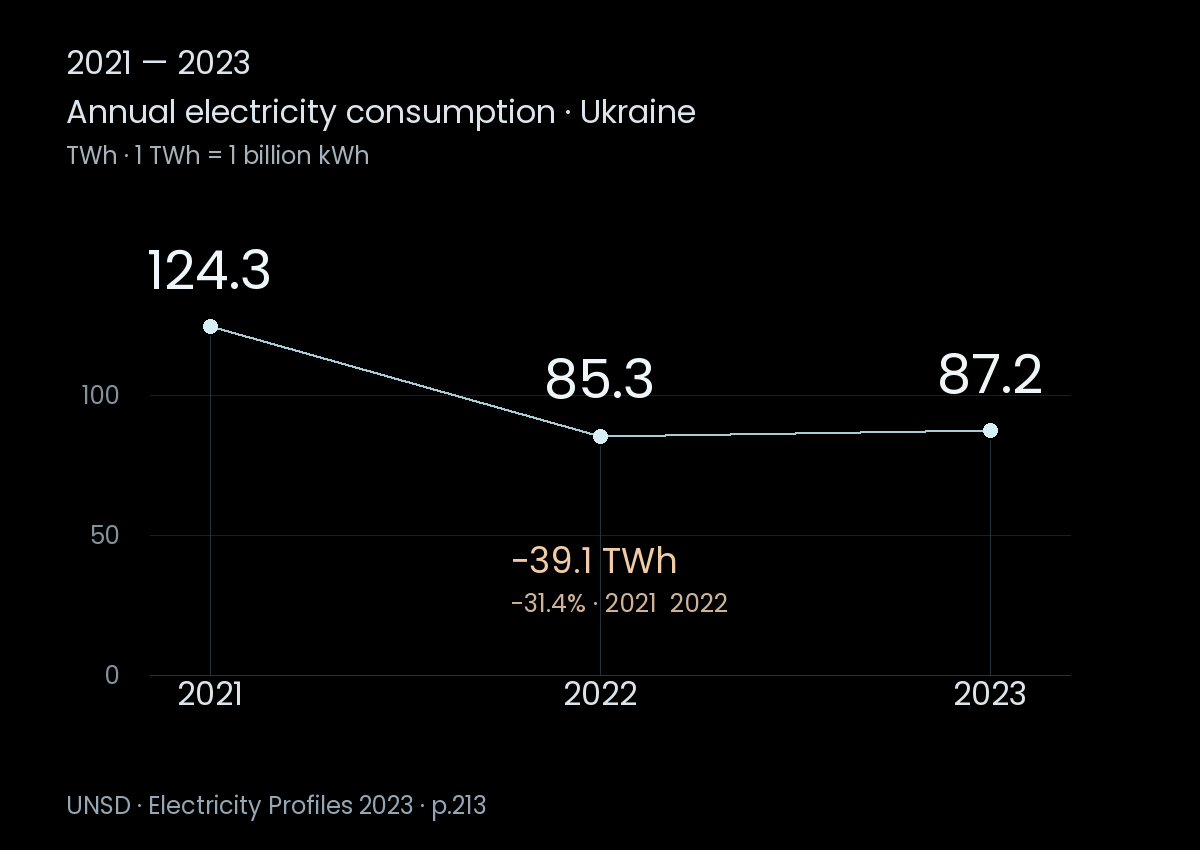
Drawn from the Consumption row for Ukraine, UN Statistics Division, Electricity Profiles 2023, p.213. Annual totals of 124,341 / 85,290 / 87,156 million kWh, converted to TWh. Source · CSV
Lower consumption reflects changes on both sides of the system: disruption to supply, reduced industrial activity and people leaving the country. The IEA reports falling industrial demand and lower household demand associated with displacement. Lost generation capacity and reduced electricity consumption describe different dimensions of the disruption.[3]
Note · Consumption includes final consumption and energy industries’ own use. Electricity/heat plant own use and transmission/distribution losses are reported separately. The decline is not solely electricity left unserved by outages, and is not calculated from satellite radiance. Wartime national statistics and the satellite footprint are not treated as having identical coverage.
The work of bringing electricity back
Restoration involves more than replacing broken equipment. In an interview with UNDP, Ukrenergo dispatcher Olena Vaskovska recalled disconnecting and grounding damaged lines after shelling in 2022 so that crews could work safely. During pauses in the shelling, staff switched to backup lines to try to keep electricity reaching consumers. Making repair work possible was itself part of restoring the lights.[7]Backup power was supplied alongside work on the grid. In May 2023, USAID’s Energy Security Project delivered 105 diesel generators to Ukrainian Railways. Such equipment supported a parallel task: keeping essential functions operating while the electricity network was being repaired.[8]

Kyiv, 16 May 2023. One of 105 diesel generators supplied to Ukrainian Railways through USAID’s Energy Security Project. Photo: U.S. Embassy Kyiv Ukraine / public domain. Photo source and reuse
Reading the months
Monthly composites also reflect observation conditions. Season, snow, clouds and short summer nights can affect what is visible, so a darker adjacent month is not a direct measure of more outages. Data Scape also offers a same-month comparison between 2022 and 2023. Exclude places with no valid observation, and read changes alongside records from the ground.Behind the lights, the work of keeping daily life going
Read alongside accounts of the fighting, electricity statistics and the words of those working on restoration, changes in light become connected to the many tasks involved in generating, delivering and using power.Returning light does not mean that life has returned to what it was. But reconnecting a home’s lighting or keeping a railway station’s equipment running helps create the conditions in which daily life can continue.
Data and representation
Six September 2021 tiles plus 144 tiles for all 24 months of 2022–2023: 150 HDF5 files verified internally and by SHA-256. Quality 0, at least four observations, finite non-negative radiance and standard deviation, Suomi-NPP. Monthly valid support varies: 37.1–99.4% of the comparison rectangle (21–42°E / 43–54°N), not a national coverage statistic. Video samples the native 15-arcsecond grid with nearest-neighbour sampling; fixed logarithmic 0–30 nW cm⁻² sr⁻¹ display scale. The video starts in September 2021 and retains August, September and October from 2022 and 2023: seven views held 2.8 seconds each, 19.6 seconds total, without temporal interpolation. Display time is not proportional to calendar intervals. Exclusions follow northern missing/patchy observation coverage rather than a desired brightness trend. All 24 months remain in Data Scape. Data Scape uses native cells sampled every 0.025°; same-month differences are 2023 minus 2022, on pairwise valid cells only.
NASA VNP46A3.002 · https://doi.org/10.5067/VIIRS/VNP46A3.002
Boundaries: UN OCHA / © United Nations. Boundaries and designations do not imply official endorsement or acceptance by the United Nations.
Sources
-
NASA Earth Observatory · Tracking Night Lights in Ukraine, 30 June 2022
-
IEA (2024) · Ukraine’s energy system under attack / CC BY 4.0
-
OSCE Moscow Mechanism · Report on violations in Ukraine, 14 July 2022, pp.28, 38
-
UNDP Ukraine · Bringing light to people against all odds: Olena Vaskovska
-
U.S. Embassy Kyiv Ukraine · Generator delivery, 16 May 2023 / public domain
Author
SORAH Editorial
October 7, 2026

![[8]](https://commons.wikimedia.org/wiki/File:USAID_Ukraine%27s_Energy_Security_Project_has_delivered_105_diesel_generators_worth_$2.7M_to_Ukrzaliznytsia,_Kyiv,_May_16,_2023.jpg)