Published on 01/October/2026 · Society
What crosses the ocean becomes part of our lives.
By SORAH Editorial
Beyond every port are people’s lives. Atlantic ship movements offer a way into trade, cultural exchange and knowledge of the sea.
Beyond every port are people’s lives. Atlantic ship movements offer a way into trade, cultural exchange and knowledge of the sea.
Explore Atlantic ship movements in Data Scape
Small lights move across the Atlantic between North America, Europe and Africa. Beyond the edge of the map lie ports, factories, markets and ordinary homes. While the ocean seems distant from daily life, journeys connecting those places continue across it.
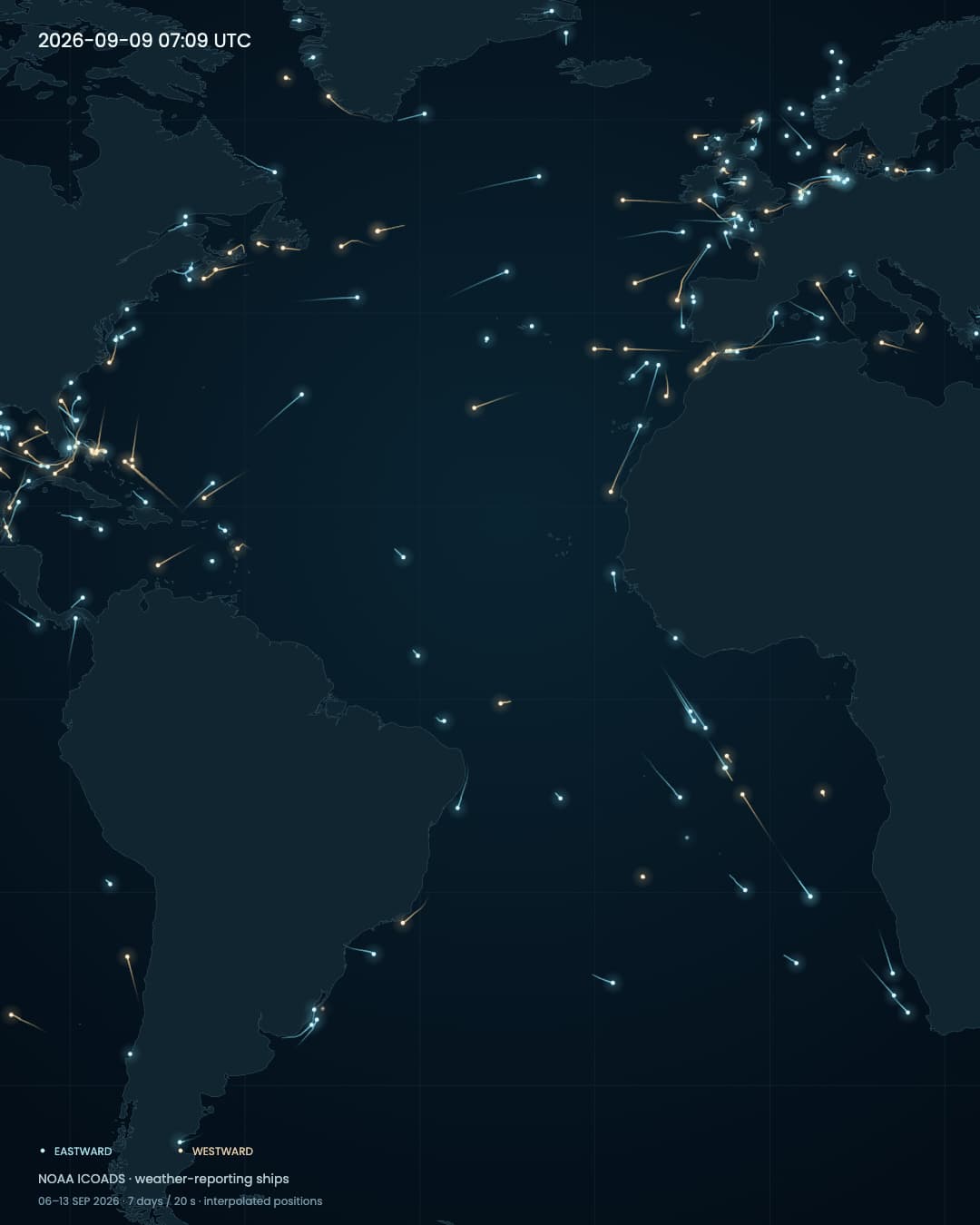
The film follows positions reported by weather-observing ships from 6 to 13 September 2026. This week of movement is an opening onto a larger subject: the work ships do in the world. [1]
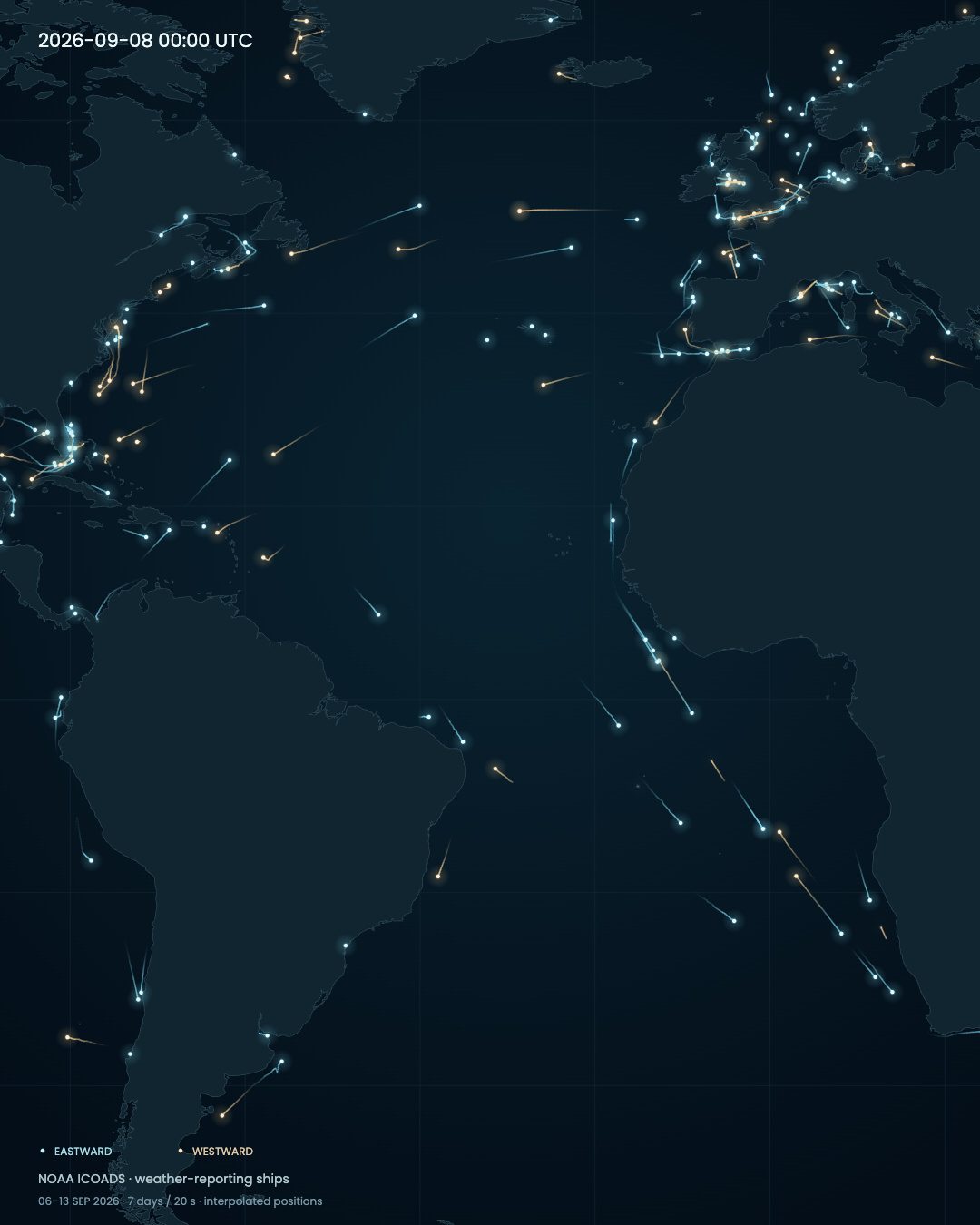
8 September 2026, 00:00 UTC. Weather-reporting ships on the Atlantic; blue-white marks eastward movement and pale gold westward movement. [1]
The table and the factory lie beyond the port
Shipping carries more than 80% of global merchandise trade by volume, according to UNCTAD. Grain, fuel, raw materials and manufactured goods move between places of production and places of use. A voyage links something made far away with another community’s daily needs. [3]Unloading at a port is only one stage. Railways and trucks carry cargo onward to warehouses, factories and shops. Trace a product’s journey backwards and, beyond the roads we know, an ocean crossing may come into view.
Disruption makes that dependence easier to see. Problems at ports and along shipping routes can spread through delays and costs to businesses far inland. Seafarers work within a wider network of dockworkers, repair crews and transport workers that keeps goods moving. [3]
People carry culture across the water
Maritime exchange has also carried languages, beliefs, food traditions and music. Ports became meeting places where people from different shores traded, settled and changed the life of a city.Liverpool offers an Atlantic example. UNESCO describes the city’s exposure to seafarers, overseas cultures and especially American music as an influence on the environment in which the Beatles developed. Sounds arriving through a port could be heard, played and transformed into new expression. [5]
Atlantic exchange also bears the history of colonial power, slavery and forced movement. Liverpool’s commercial growth cannot be separated from its role in the transatlantic slave trade. The relationships built through shipping include both cultural exchange and systems that deprived people of freedom. [5]
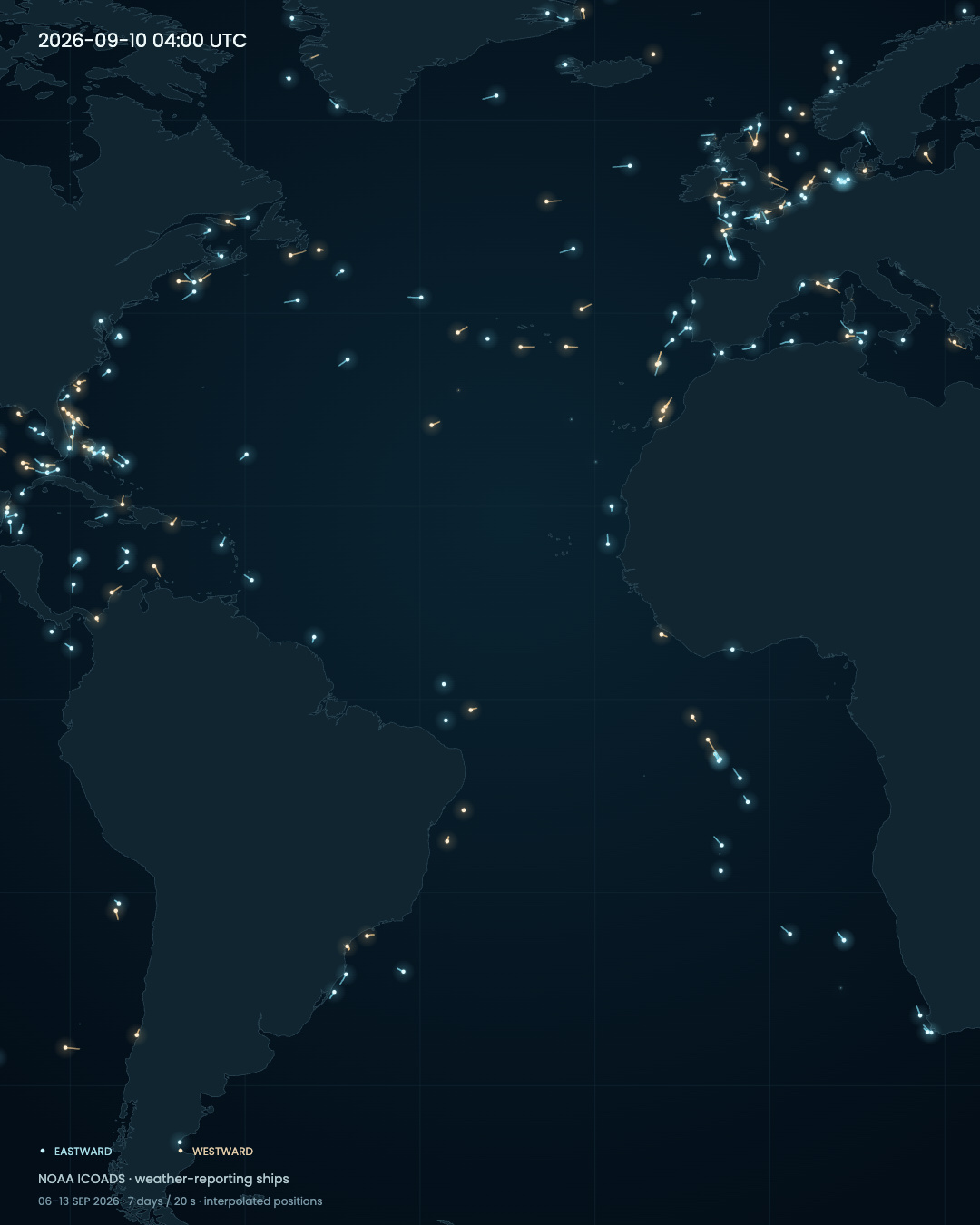
10 September 2026, 04:00 UTC. The same Atlantic view, with ships at a later point in the week. [1]
Learning about the sea while crossing it
Ships can also report the conditions they encounter. Permanent observing stations are difficult to maintain across vast oceans. Reports of wind, pressure and temperature from vessels contribute to forecasts, warnings, safe navigation and the study of climate. [2]The positions in this film come from ICOADS, a collection of marine weather and ocean observations. Each recorded location is evidence of a ship passing through a place and of information received about conditions there. [1]
Beyond the edge of the map
Follow one light until it leaves the frame. A voyage continues toward other ports and other people’s work. Across many journeys, ships have helped supply tables, sustain factories and bring cultural influences into cities.That is another way to look at the Atlantic: through the lives connected by its crossings. A distant vessel becomes one part of the long process through which everyday life takes shape.
Note · Data and scope Preliminary NOAA ICOADS records for identifiable weather-reporting ships, 6 September 2026 00:00 to 13 September 2026 00:00 UTC. This is not a census of vessels or a measure of trade volume; vessel type, cargo and purpose are not identified. The discussion of trade and culture provides social and historical context, not claims about the cargo or destinations of individual displayed ships. [1][3][5]
Note · Representation Positions are interpolated only across observations up to six hours apart. Longer gaps, implied speeds above 50 knots and land-crossing connections are split; segments moving less than 10 km in total are excluded. Trails show the preceding 24 hours, with beads sampling the same trajectory. The processed series contains no connected active tracks from 9 September 14:00 to 10 September 00:00 UTC; this ten-hour interval is skipped. Remaining records play in twenty seconds, about 28,440× faster. Blue-white indicates eastward and pale gold westward motion. Land: Natural Earth 1:50m. Preliminary observations may be revised. [1][4]
Sources
Author
SORAH Editorial
October 1, 2026