A phone charges. A train motor turns. Behind these familiar actions lie rocks formed long ago and people extracting useful materials from them. Starting with rare earths used in motor magnets, we also follow lithium and cobalt used in batteries. Mapping these resources brings their different roles in everyday products back to particular places.
Lithium (Li) and cobalt (Co) each name a single chemical element. Rare earths, by contrast, are a group of 17 elements: the 15 lanthanides, including neodymium, plus scandium and yttrium. Neither lithium nor cobalt is a rare-earth element. [1]
The shared frame here is their role in modern equipment and the risks surrounding their supply. “Critical minerals” is an economic and supply-security category, not a chemical family. In the United States, it concerns essential minerals and materials whose supply chains are vulnerable to disruption. The map therefore brings together different resource pathways into batteries and motors; it does not present three equivalent elements. [2]
The IEA’s Global Critical Minerals Outlook 2026 puts concentrated supply and export controls at the centre of economic-security concerns. China’s rare-earth export controls in 2025 affected operations at some automakers. A missing material can interrupt production far beyond the mine that supplies it. The amount underground alone does not explain that relationship. [3]
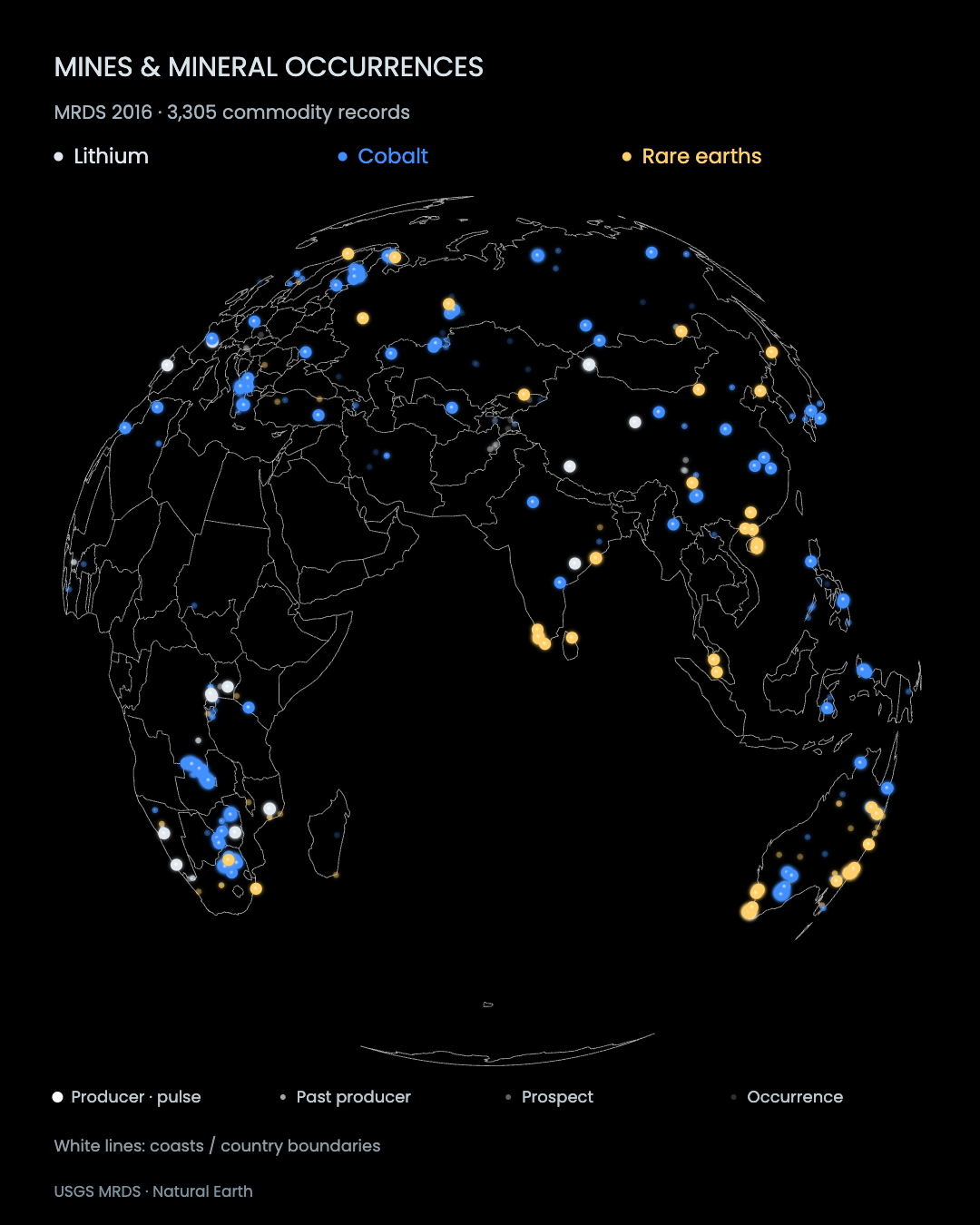
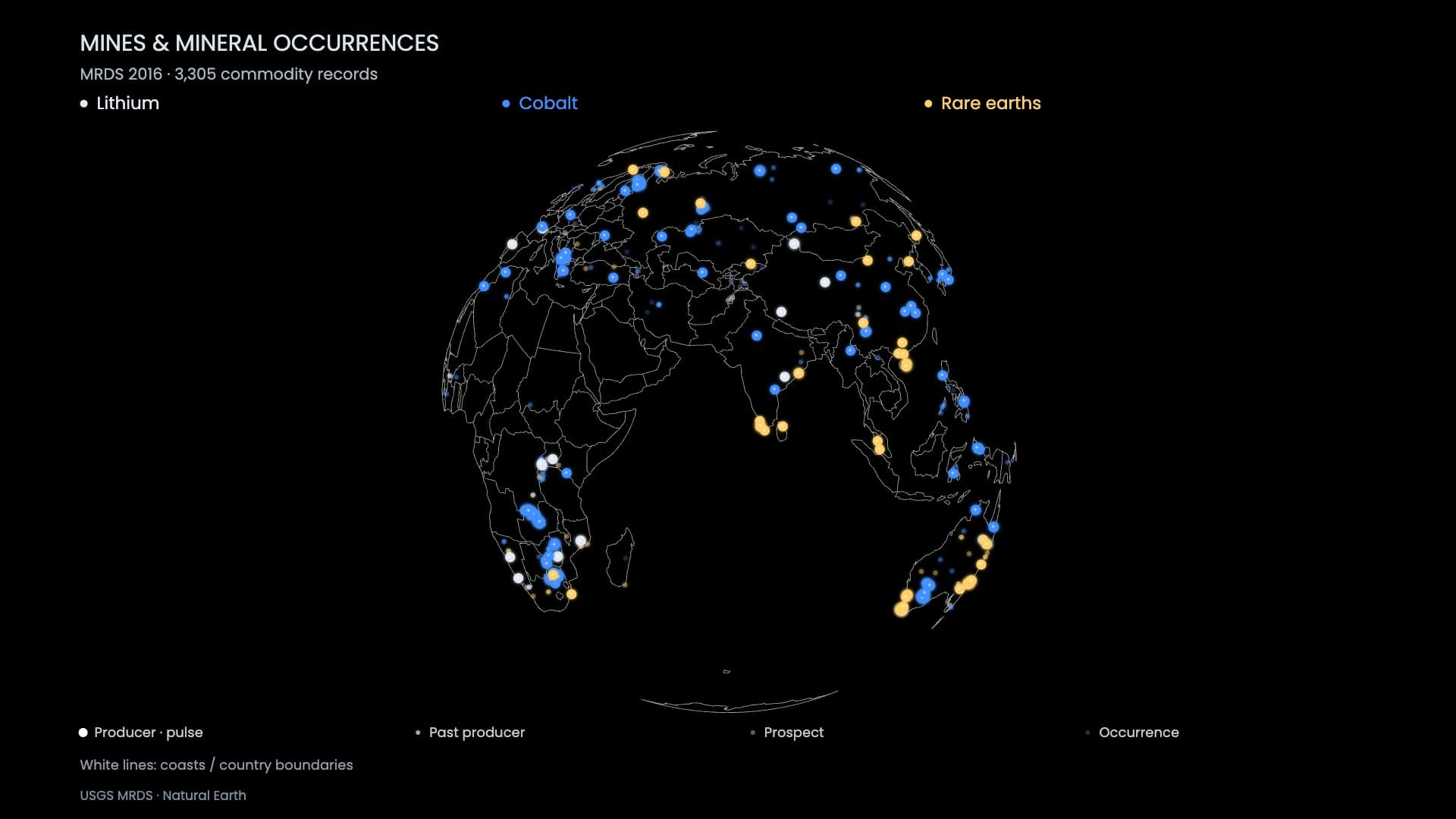
USGS MRDS 2016. Silver: lithium (element); blue: cobalt (element); gold: rare earths (element group).
Materials that store electricity, materials that create motion
In a lithium-ion battery, lithium ions move between two electrodes during charging and discharging. Their movement, coupled with electrons passing through an external circuit, allows energy to be stored and released. A battery is more than a container filled with electricity: it repeatedly uses changes in the state of its materials. The percentage on a phone’s screen has a physical process behind it. [4]Cobalt is used in some cathode materials, but not every lithium-ion battery needs it. Lithium iron phosphate, or LFP, uses a different combination. Changing a battery’s design changes which materials it requires. Future resource demand is shaped both by what exists underground and by what people choose to manufacture above it. [5]
Neodymium, one of the rare-earth elements, makes strong, lightweight magnets used in electric motors. Often discussed alongside battery metals, it performs a different job. Storing electrical energy and turning electricity into motion call for different material properties. Those separate roles meet inside a single device. [6]
Geological time is older than national borders
At Mountain Pass in California’s Mojave Desert, the stepped walls of an open pit give physical scale to a point on the map. The rare-earth deposit is associated with magmatic activity around 1.4 billion years ago. Carbonatite, an unusual igneous rock rich in carbonate minerals, is central to its geology. [6]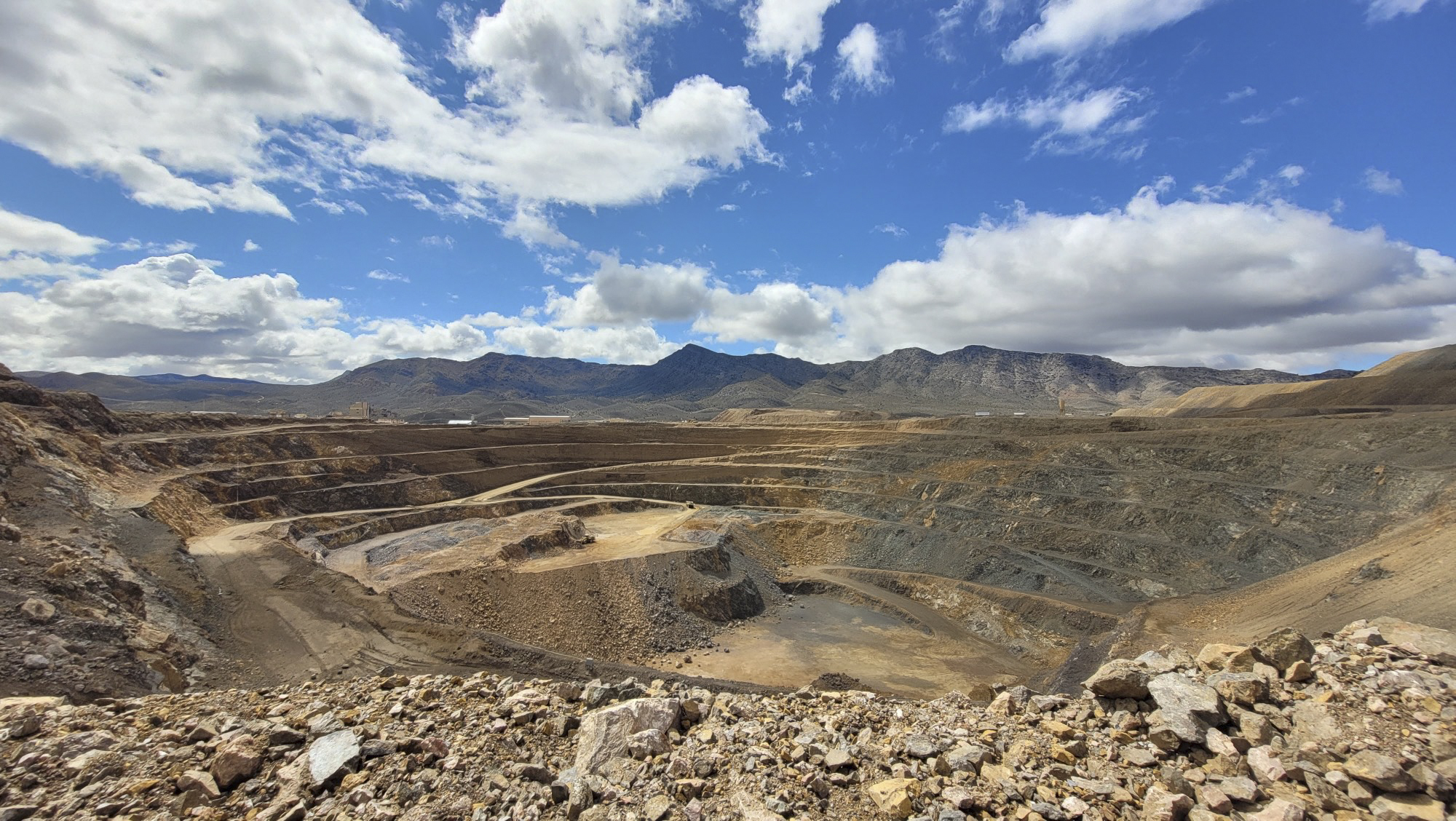
Open pit at Mountain Pass, California. T. Morton / USGS, public domain. Published 29 March 2022; capture date unknown. Source
A mine is both a working industrial landscape and a place where deep geological history becomes exposed. Borders divide present-day trade and administration. They did not divide the processes that formed the deposits. Moving from national production rankings to individual locations reveals another geography beneath the political map.
Lithium can occur in hard rock and in salty underground water. A USGS review identifies pegmatites, continental brines and hydrothermally altered clays as its three main deposit types. Lithium-rich brines develop through combinations of aridity, closed basins, suitable sources and time for concentration. Chile’s Salar de Atacama and Nevada’s Clayton Valley are concrete settings in which to understand those processes. [7]
Even for the same element, working with rock and working with brine require attention to different ground conditions and water systems. A single resource total can hide these differences. A location restores them. Sharing a material name does not mean sharing a landscape or a way of extracting it.
A bright point can mark different stages of discovery
The globe brings together 508 lithium, 1,520 cobalt and 1,277 rare-earth (REE category) commodity records from the USGS Mineral Resources Data System, MRDS. Silver and blue refer to individual elements; gold refers to records for an element group. A location can appear under more than one commodity. These counts are neither unique mine totals nor a ranking of elemental supply. [8]Opacity distinguishes recorded producers, past producers, prospects and occurrences. Places that have been worked appear alongside places known through investigation. Finding a geological sign, establishing usable quantities and qualities, and producing a material are separate stages. Between them are decisions, investment and human work. These are historical classifications, rather than a live inventory of operating mines. [8]
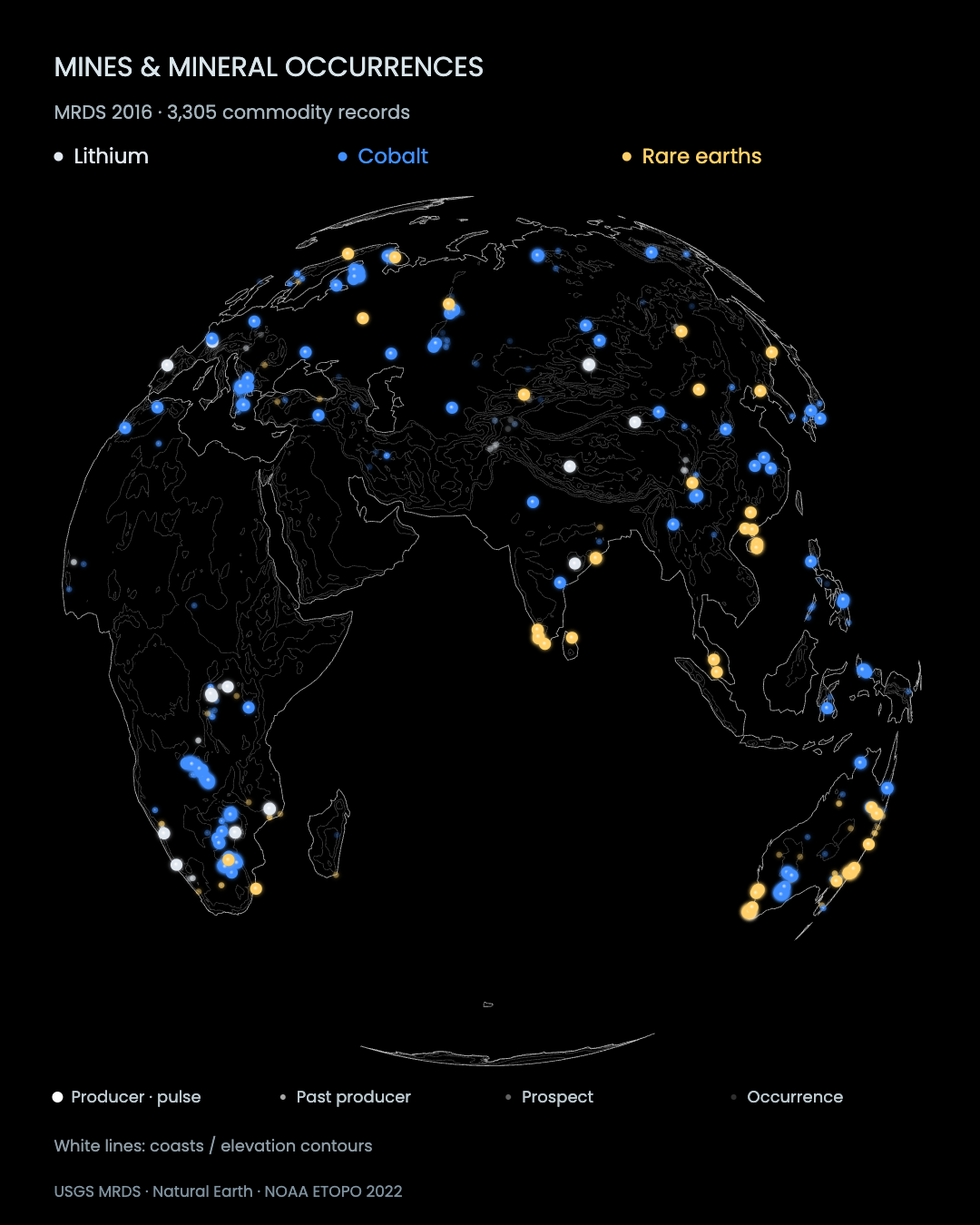
The same sites with white elevation contours. MRDS / NOAA ETOPO 2022.
Locating a deposit is only the beginning of supply
Extracted ore must be separated and prepared for use in a battery or magnet. The IEA finds that refining and downstream manufacturing lag behind mining in plans to diversify supply. More points of extraction do not automatically mean more complete routes to a usable material. [3]That gap makes the work between the deposit and its users visible. A supply chain also requires skilled people, functioning equipment, transport and continuing trading relationships. What appears to a buyer as one material depends on several places and several kinds of expertise. A mineral map is therefore a starting point for following connections, rather than the end of the explanation.
Follow the material as far as the people who mine it
Working conditions belong in this picture. The US Department of Labor’s 2024 findings document children performing dangerous tasks in cobalt- and copper-ore mining in the Democratic Republic of the Congo. This is not a description of every mine in the country. It identifies specific labour concerns that need to be examined when tracing material supply. [9]Conditions at a distant site are difficult to see in a finished device. Knowing its country of origin is only one step toward understanding the workplaces and arrangements through which a material passed. Efficient supply and the lives of the people who provide it are questions along the same route.
A used product can also be a source of material
The IEA’s report on recycling treats recovered materials as part of supply security. Processing capacity alone does not ensure that end-of-life products reach it. Collection, sorting and demand for recycled outputs must connect before a discarded device becomes a source for another product. [10]Geology strongly constrains where deposits occur. Society has more choices about how long products remain useful and how their materials return. A point on a mineral map need not be read as a place where the future is already decided. Recovery adds another route alongside extraction, and another way of relating to the resources already in use.
Return the globe to the device in your hand
Silver, blue and gold marks pass across one turning Earth. Under them lie rocks left by ancient magmas, brines concentrated in dry basins, and records of investigation and extraction. Beyond them are the people processing materials, designing equipment and charging the devices they use.A map of critical minerals can do more than identify where to extract the next tonne. It can help us ask which places and people support the things we choose to make. A small battery or motor becomes a connection to geological time—and to the working lives that make its materials available.
Data and representation
Filtered the official MRDS CSV, edition 20160315, for Lithium, Cobalt and REE. Excluding Plant and Unknown yields 508 lithium, 1,520 cobalt and 1,277 rare-earth (REE category) records. Source data are retained; exclusions are applied in the display.Commodity categories follow the source fields Lithium, Cobalt and REE. REE is a grouped source category, not a sum of separate queries for all 17 elements. A gold point does not identify the presence or quantity of each rare-earth element and does not mean all 17 occur at that site.
Original dev_stat retained. Producer means producing at data entry, not today. The four classes use maximum opacities of 100%, 65%, 38% and 18%, respectively. Opacity encodes classification, not production or resource quantity. Systematic updates ended in 2011.
One mark represents one report, not necessarily a unique mine. Byproduct minerals are included. Symbol size does not encode output; 2025 national production is not assigned to sites.
Coverage is strongest in the US and incomplete elsewhere. Record density is not resource abundance. Coordinates use WGS84; positional quality varies.
no land fill. Context boundaries use Natural Earth. ETOPO 2022 contours at 500, 1000, 2000, 3000, 4000, 5000 and 6000 m are extracted from a 1024×512 overview grid. They do not show temporal terrain changes.
Pulsing identifies records classified as Producer at entry. Their opacity cycles from 25% to 100% every two seconds; other stages stay constant. This does not show present-day operation or changes in production.
Producer marks have twice the diameter of other stages. Size distinguishes the recorded stage; it does not encode production or resource quantity.
Sources
- USGS · Rare Earths Statistics and Information
- USGS · What is a critical mineral?
- IEA · Global Critical Minerals Outlook 2026
- US DOE · DOE Explains… Batteries
- US DOE · Technology Strategy Assessment: Lithium-ion (2023)
- USGS · Mountain Pass REE mineralization
- Munk et al. · Lithium brines: A global perspective (2016)
- USGS · Mineral Resources Data System / metadata
- US Department of Labor · 2024 Findings on the Worst Forms of Child Labor
- IEA · Recycling of Critical Minerals (2024)
Author
SORAH Editorial
October 8, 2026